
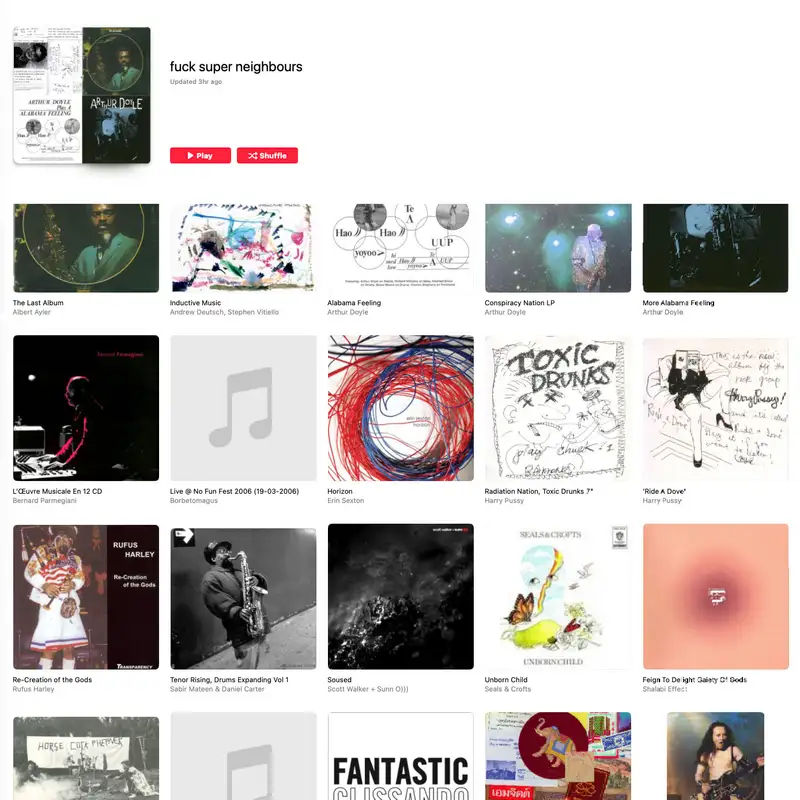
Episode 14: Fuck Super Neighbours Playlist ft. Mark Loeser
It's a joy to be alive. It's good to be glad. Good to survive. It's great to be mad.
Jstin:Hello? Episode 14.
Mark:Hello? Hello? Hello? Hello?
Jacob:Hello, Mark.
Mark:Hi, guys. Oh,
Jstin:that's so great.
Leon:Mark That
Mark:song has never felt so long. I was so excited to get
Jstin:started. I hope the shorter version too. There's two. That's the
Mark:the cadets one. I hope that all the viewers, all the listeners have heard that or seen that. Jeez. I'm getting sort of aphasia going on. I hope that everybody's seen that film.
Mark:That's such a a gem. That's the theme song from.
Jstin:I highly doubt it because when I had one of the Herman Nietzsche actors here who worked at the Viennese Actionist Museum Oh. Did not know that film existed. And none of the people that worked, including the curator of the Viennese Actionist Film Museum, did know that film. The only person at the niche that I brought that film up with that knew it was was Carolina Urbeniak, who runs a press, like, of a kind of of a, you know, transgressive literature in The UK. But no one from the niche people knew that movie, which was pretty startling.
Jstin:And when when Rico was here, one of the actors, great really great artists too from from Vienna, He did a residency in our space, and he he was he was floored by it. Like, it was like it completely changed how he understood Mule. It completely changed how he understood actionism. It was like a very, very mind blowing thing for him. So yeah.
Mark:I I thought you were gonna say it completely changed how he thought about me. Well, that's a that's a that's a real divisive film. Would think you really you find out who's on one team or not.
Jacob:I've lost
Jstin:friends over that film.
Mark:Yeah. That's the way it starts too, I'm not gonna describe what that competition is, but if you get past that, I think you're doing okay.
Jstin:Although that was startling because how completely spot on for the current moment, like, Trump and the purity stuff and all the Turning Points USA. Like, it was just like, holy shit. This is, like, right now. So, anyways, but Wow. Welcome, Mark Loeser.
Jstin:This is too
Leon:Mark Loeser.
Mark:We have to introduce
Jstin:Mark Loeser. This is so exciting. So Mark is a very OG esoteric. You knew esoteric. You brought me into esoteric the first And, you were you Mark is for everyone who is not aware of Mark Loser, Mark Loser is a hero in the, in the esoteric world.
Jstin:Great experimental filmmaker, legendary experimental filmmaker, Canadian experimental filmmaker, incredible film processor, runs one of the last labs in the world doing beautiful, beautiful film processing. He's a great philosopher, reader, human, all of these things, and one of of, like, our best friends of the pod and who gets mentioned in almost every pod. So we're very excited to have him here to guest host with us and and a a fantastic human being and an amazing listener of music. So, Craig, welcome to the to the podcast.
Jacob:Welcome. Welcome.
Mark:Welcome. Wow. We could do a whole episode of just passing flattery back and forth. That was that was something. That was I'm totally discombobulated now.
Mark:It's but it has been funny listening to the podcast and it creeping up on me how often my name has gotten dropped on this show. I'd I'd I'd shared it with a few friends early on, and then it felt like, what a vain dick. Like, there you should check out this show that's about people mentioning me pretty random regularly. But, yeah, it's it's it's an honor to be here. It's great to see you all too.
Leon:Yeah. Absolutely. I have to say that I was super excited to have you on because when I mean, one of the 100 times that your name came up as as a guest host, I immediately heard your voice in my head. And I was like, yes. Mark Loser is the perfect person to have on any podcast about anything because he has that voice.
Leon:Yeah. The Mark Loser voice.
Jstin:The voice.
Mark:Wow. That's nice. Well, we
Jacob:should we we should test that.
Mark:We should make a podcast for anything and see if we could actually keep anybody listening. I'll I'll I'll try to keep them on the hook, but K. That's that's that's kind. It's yeah. It's it's it's been it's been funny listening to the podcast too because I don't know if it's I'm sure everybody that had a relationship to that store felt very, very center stage.
Mark:You guys were always so amazing for making everybody's taste in music grow. And and what was really special about that store for anybody that doesn't realize is how much anybody walking in that had a CDR became the featured musician in the store. I mean, was a friend, the trend that in any other music shop would have been whatever a record company was pushing and you guys were always pushing just people's own music. And the way that it it created the community that we had for those years was was really impressive. But I feel I feel like the I I feel like the fifth Beatle.
Mark:I mean, I feel like because I didn't work there, but because I lived with with with both Justin and Jacob and was was at the store often enough on my own ambulations, it it it really felt close to my heart. So, yeah, it's nice. You remember brought it back.
Jacob:Do you remember actually the first time you ever went to the store? Because I wasn't I think we must have gone there together, and I wasn't even working there maybe because I had known Mark for, like, in Montreal very early on, and we would always be interested in music together. And then I think we must have gone to that store before I started working there. And then just
Mark:I think we were working at at HMV. We met in in in film school. I can remember I I I don't know if you remember this, Jacob. Our first two sort of there was like a a one two punch for us becoming friends. One was we were talking about films that we'd done before getting into the program, and you presented something where you put Mersbo on the soundtrack.
Mark:So I remember thinking it was pretty good day one meeting here. And then we and then we ran into each other again at a show.
Jacob:At a show.
Mark:Yeah. Neither of us knew who the recording artist or the the artist was, but we were both attracted by this guy, Sam Shalabby. Yeah. So we went to a Shalabbi show. And I remember I was there with as as as some some some friend, and you and I started talking.
Mark:I just forgot about her completely. We were talking about, you know, Yamatsuka Ai and Mersbo, and and we just got into we got into a fever. It was it was pretty terrific. And the show was great too.
Jacob:Yeah. And I think Sam also started talking with us as well. I recall he was he somehow joined in or we were somehow started a conversation with him. And in the classical style of Sam Schlabbe, he then asked us, are you guys musicians? Yeah.
Jacob:Do you do you make music? Actually.
Jstin:One of
Mark:the things one of the things that I was trying to find, not not knowing if it would be you know, have enough merit to share on the show, but Jacob, I was trying to find the thing that we used to do a lot early days together be like in the dead of winter when winter in Montreal was still very serious feeling. It felt like another planet. You'd you'd trudge over with some some music gear, and I don't think with instruments. Just with whatever recording or or microphones we had, We just improvise. And I think the only I think the only microphone we actually had was on a Fisher Price pixel vision camera.
Mark:So we just laid it on the floor, and it would record this sideways snuff film of our feet as we were making pictures. It was it was wonderful. Yeah. I was trying to find that stuff, but it's it's somewhere. I can't I can't I can't locate it.
Mark:Yeah. Yeah. That's
Jacob:that's a great place.
Mark:Gold. This is absolute gold. Well and then, I mean, Justin and I, we go back much further even. And I can think of I've I've been thinking of a lot of memories of our listening to music. Boy, it goes I think it was, like, the sounds of the world evolving so long ago.
Mark:Yeah. I was thinking about working in on on Commercial Drive at the Puffy bar and listening to Morton Feldman on the tape deck in that bar. And this was not a place where anybody wanted to hear Morton Feldman apparently because somebody stole the tape.
Jstin:Maybe they really wanna
Mark:do it.
Jacob:You know?
Leon:Yeah. It could go by
Mark:I'd like to think that.
Jstin:This is also for context for this place too. This was also a place that had holes drilled in the spoons because people were cooking up heroin in the bathroom. That's right. So, like That's this is, like, a very intense vibe for listening to Morton Feldman. And, yeah, very beautiful, beautiful place.
Jstin:It was a it was a very special place. Of course. And, Mark, to that effect too, thinking about I I have memories of Kelowna listening with you, of listening to Herbert Distel del Dirisa Yeah. Which was the first like, you think about this. This is eighties, maybe, like, '89, and it was, like, field recording stuff, like Mhmm.
Jstin:Of a train voyage in Eastern Europe. Like and then the first thing I'd ever heard of of of, of field recording stuff and so far ahead of that world emerging, and it was kind of like theater for the ear stuff. But it was it was like you and me sitting in one of our parents' garages or or, like, you know, whatever, like, listening to this than just being like, this is the best thing on earth. Like, I still love that, like, that record. That's crazy.
Jstin:On hat too. Yeah.
Mark:Oh, dear hat hearts. Yeah. I mean, yeah, it's incredible that we've been listening to music together for long enough that I can think of whole shifts in how music was made. Like, can remember Bernhard Gunther when that came along and Pro Tools started being a tool. Suddenly, music changed.
Mark:I mean, not all music, but some music really, really took a turn. Yeah. And there was a Mini disc reporter. Fidelity. Yeah.
Mark:The mini disc reporter. Well, you're talking about, DISA. I think of how, you know, it's this this this treat of looking back at your life and how the things that attracted you, they became us. Like, that you've got this podcast now from those roots. I think of how, you know, the Ureisa influenced you, I'm sure, to get a couple PZM mics when you went
Jstin:off to
Mark:Yeah. And Justin Justin went went off to India and sent me back when I just moved to Montreal to start film school. Super eight cards needed processing and mini disc recordings, and it was incredible. It was it was really it was really special. And that's before, you know, I think we we we knew we'd what world we'd enter.
Jstin:Although that Super eight card that I sent, this is such a crazy story.
Mark:So Oh, yeah.
Jstin:One of like, to me, this is the greatest work of art I've ever made, this this one cartridge of Super eight that we shot. And I can remember specifically the things that were shot on it. There was a children attacking and destroying a old Indian wedding float of swans with trumpets and then playing through the trumpets and annihilating it and, like, tearing it in pieces. I'm sure in my memory, it's gotten way more graphic, but it was incredible. And then being at the gate of the Nepalese prison, and on the one side of it where it's the conditions in in the prison in Kathmandu are, like, really, really horrifying.
Jstin:And on the one side of the gate, you pass, like, kind of gifts through to the prisoners so they can stay alive, like potatoes or oranges or whatever. And on the one side of the gate, it said and I remember shooting this. It said, fascination is the root of all suffering. I've never stopped thinking about fascination Wow. As the the word that's chosen for that.
Jstin:And then on the other side of the gate and this is like, you know, there's a lot of suffering going on in there. Suffering is the first step on the path of enlightenment.
Leon:Oh.
Jstin:Pretty heavy. So and I remember shooting this and thinking these two images were incredible together, and I sent it to Mark. I can't remember if I mailed it from India or if I brought it home, but he sent it to Mark because he knew I think he took it to, like, Shoppers Drug Mart to get Super eight processed back then.
Mark:Was crazy. There was a brief yeah. There was a great brief moment where you could take Super eight parts and just drop them off at any Shoppers Drug Mart because Qualex was doing all the processing. And so they'd take the Super eight with a lot of confusion. The kids would be really, like, misdemeanor.
Mark:They'd be like, is this video? They'd just take it. Yeah. I'm glad I'm glad I'm glad you inserted that. As a processor, I would not mix up somebody's orders lately now.
Mark:So this the one before.
Jstin:Is then at the end, I I came to Montreal
Mark:a few months later.
Jstin:Gotten it back, and we got somebody's bad out of focus footage of lights in Amsterdam. So I've never ever seen that footage. And I think about somebody who is expecting their trip, like, tourist trip to Amsterdam getting this just super heavy footage from India.
Jacob:So yeah. That's incredible.
Mark:If you're out
Jstin:there listening, please
Mark:send me the I used to I used to I used to be living right then at on Guildford right across this tiny little parquet, just sort of like a block diagonally from from Montreal and Saint Denis. And I would sit in my in my door to my apartment, which opened right onto the sidewalk, and I had a Super eight projector beside me.
Leon:I would project onto a
Mark:little portable screen in the parquet. So people would walk past and walk through the the Super eight parts that you'd sent. Unfortunately, nobody said, hey. That's my role. This is You
Jstin:know, I have in in the neighborhood here when I walk the dogs, I almost every single day walk by down that alley that we used to we lived on Mark lived on Saint Dominic, and I'd visit there, and we project onto the back of the Canadian Tire, like, when I was there, just sit and drink and watch, you know, like, watch weird projections on the back of the Canadian Tire. And I walked by that, and, like, I always expect someone to have taken up that baton. And that's like, come on. Start the projections again. Missed that.
Mark:It's a it's it's it's it's a it's a it's a sweet and agonizing situation that that the lab that I'm running is at it's at TMU in in Toronto. It's this campus based lab that can can allow our film students to shoot an enormous amount of film. I'll process something like between five and six hundred rolls of student films a year. But I can I can track the the students that might be lucky enough to get their own equipment? And the stuff is so inflated in price now with Arbitrage on eBay and stuff.
Mark:But what a difference it made living with all the materials needed to to live with analog film and to be able to I mean, processing it in buckets in the bathtub was a step beyond. But doing doing just projections as a as a as a fact of life and shooting just just like like you'd have a sketch pad. Mhmm. It was a beautiful way to engage with film. It's it's still I still get to do it, which is astonishing thing.
Jstin:I have this crazy memory of you and Brian Vorostek moving an editing suite into somebody's apartment upstairs. Yeah.
Leon:Yeah. Yeah. If you think
Mark:about those spiral staircases in Montreal Yeah. The two of us the two of us moved. It wasn't a steam bag, but it was a similar similar device up a spiral staircase alone. And I think I only lived with it for a year. We turned it into a contact printer, and it was, yeah, it was a real privilege.
Mark:I would never ever do that. For myself, I would never do that again, but I've done it a of times for friends since.
Jstin:Yeah. It's But
Jacob:you had Esteembek at home, didn't you, in your place? Well, Brian's.
Mark:It was Brian's. Yeah.
Jacob:That's Oh, it was Brian's.
Mark:Yeah. It wasn't Esteembek. It was a different brand. It was a a Buick. It was a better brand, actually.
Mark:I'm forgetting the name. It wasn't Itrageny. It was oh, I think we've lost all the listeners at this point.
Leon:Yeah. It it's turned into a whole other podcast. Yeah.
Mark:Yeah. It's okay. Like, I heard this was an avant garde music podcast.
Jstin:Speaking of which, Mark Loser, you have to play our first track.
Mark:Oh, thank goodness. I'm so glad because it it is it is related to to what we were talking about a little bit in terms of the the the your ears opening to field recordings and how important that it was is a facet
Jstin:of of what we sort
Mark:of were drawn to, and I I'm sure it's shaped both of our our well, all of our lives. And this is almost by request because, Justin, this is in one of the several mentions of me on the show. You you called this one out, but you couldn't quite remember correctly. You you I think you you remembered as being the the Mali version of Terry Riley's in c. But in fact, this is
Leon:let me get some context. Wow. Yeah. Oh, I'm excited.
Jstin:Oh, this is This is really exciting.
Mark:And this has been stuck in my head ever since I heard it many years ago. I don't remember where you would heard it. Think you would just I don't know if we were living together anymore.
Jstin:Yeah. We were. You played it for me.
Mark:So any any students of musicology that or would be listening to the podcast, they might have heard this because there was a a textbook called Worlds of Music, an Introduction to the Music of the World's People. And this was recorded by an ethnomusicologist named James Cotting who did a bunch of field recordings in Ghana. I think he introduces it pretty sufficiently. So let me figure out how to oh, no. I have to figure something out again.
Mark:Where's I hit share. This is really building suspense for listener. I hit share, and then I hit here we go. Selection 13, postal workers canceling stamps at the University of Ghana post office.
Jstin:Incredible. Well,
Mark:that's how it works. I don't wanna work at the post office. Whenever I find myself doing some repetitive task or working I mean, maybe twenty years later. I don't know how much how much longer ago it's been since I've heard this this track. But I start whistling, and I start I maybe don't do it out loud, but it's in it's it's the it's the thing that motivates me and gets me going.
Mark:It's a really it's a really remarkable little earworm.
Jstin:I think it's amazing that I I mistook that for in.
Mark:They're both special. They're both I can see I saw the connection. I knew what you're talking about immediately.
Jstin:I I think that they I heard both those at the same time, but this is yeah. That's really smoking. That's amazing. It's so good.
Mark:I was tempted to call the University of Ghana post office just to have another list. May they still be grooving. Is this
Jacob:whole CD like a compilation of that kind of of field recordings?
Mark:What was this from? I don't even know if I have the whole CD. I think a track. That well, now that really begs the question, why do I even have this? Because I didn't I didn't study music.
Mark:I I don't know how I came across that track at all. But, yeah, I would I'm gonna just go out on a limb and suggest that it's probably just all field recordings of of of of music from different parts of the world.
Jacob:From different post office.
Mark:That's really amazing. Different shifts at the same post office.
Jstin:They missed the Catholic post office. Johnny's
Mark:got no rhythm at all. That's why I'm not playing that track. But it it it's, you know, that that kind of that openness to the sounds of the world. I think it it it has a lot to do with our collective tastes, and it has a lot to do with this this slow realization as I've as I've got this growing problem of traveling and shooting a ton of footage and getting a little tired of my own style of filmmaking, getting disillusioned a little bit. Anytime I'm shooting video and there's music in the world, it feels like the greatest thing.
Mark:I mean, it's great getting good images, but getting the sounds that somebody is is putting music into the world around you and capturing that, I I I would love to to to use that as an organizing principle at some point.
Jstin:This is so essential too because the music that's captured that way is not the music that's captured by intention and recording and desire to make it. Like Yeah. I just watched last night, mind blowing Bill Egleston's Stranded in Canton, which is quite hard to track down.
Jacob:That's a great film.
Jstin:But the the amount of music that he captures in it that is just people playing music in in Memphis and not, like, for any other reason than just playing music and getting wasted. It is so fantastic, and some of the music in it is just, like, mind shattering. Like and it actually makes because it was recorded in '74, which is right after Big Star recorded, third and just before flies on Sherbert. And that transition from, like, Alex Chilton's kind of fragile, gorgeous pop to his, like, reckless, damaged, crazy, whatever that stuff was, makes so much sense watching that movie. You're like, oh, I understand how this happened.
Jstin:It really, really, really brought to mind Passe Lemani in a lot of ways. And and the vibe of that that time and place was a little bit more lead in the gasoline, and I think you'd wind up you'd wind up in in Canton. But it's yeah. That's a but to the point of what you're saying about music, like, you you see people making music because they're making music for no other reason, and this is the greatest music, like, to me always.
Mark:I think of I I I think of a piece that I I thought about bringing to the show, but maybe we can just give it a mention instead because I I I wasn't satisfied finding one track, and it's such an incredible visual piece. But I think somebody you introduced me to, Justin, Christophe Chasseult, and I think of this astonishing thing. Leon and Jacob, if you haven't seen this, on YouTube, anybody can find there's a thing he did called India Moor where he went to Calcutta and he went to Varanasi and shot video of street musicians. And then he has this beautiful technique that he does of taking everything that we're talking about, but then enriching it by overlaying it with his own music that is honoring the rhythms of the music. It might even just be somebody speaking and the song if they're talking.
Mark:And then starts cutting the video musically, so it starts really focusing on and framing beautiful bits of musicality. And it's it's So I'm getting emotional even just thinking about it. And I've shown it to people, and they've just cried. I mean, it's such an elegant, beautiful way of honoring sound in the world around us, and it's, yeah, it's amazing piece.
Jstin:Yeah. He's great.
Leon:But Yeah. Just to go back to the piece that you played, Mike, the I mean, we we just listened to an amazing document, obviously, of of some music in the world that's quite literally alive. Like, it's it's being made as it's recorded, but it's we're kinda blown away by how musical it is by, you know, like, the the kinda aesthetic qualities of it and also the context of, wow. This is a post office, and that's the post office sounds, and they're but it's completely mind blowing that this is music that has been forming over, like, god knows how long Yeah. Yeah.
Leon:In order to Yeah. To get there. And it's still, like, in the process of of changing. Yeah. And that's, like, serving a a real function.
Leon:It's, like, you know, to to alleviate the drudgery, to Yeah. Make it more efficient at the same time.
Jstin:Also, active resistance against capitalism and need to, you know,
Leon:like, fuck. Yeah. But also, like, folding in, you know, newcomers, like a way of of, you know, getting people involved with the the the unit of of everyone working together. It's, like, really incredible. Like, I you know, it's it'd be amazing to hear, like, previous all the previous iterations, like, the the of of this of this music as well.
Leon:So it it sounds like super contemporary. It's like on a quote, unquote world music CD. So in a sense, it is traditional music, but it's like a a very living form of yeah. It's it's really amazing in all those respects. Yeah.
Leon:I hear you.
Mark:Well said.
Jstin:I just wanted to say that, like, for me, this is the greatest thing about doing this podcast with you guys and for you to be back in it, Mark, is that back at the time of the store, we would bring these things to each other. Like, you brought that to me like a great treasure. You know? And it was like, I would come home from the store, and you'd be like, hey. Check this out.
Jstin:And we'd sit and listen to it, and I would be like, what is this? And, like, the velocity of life, like, for me, I would say from at least 14 years old to maybe 38, like, that discovery of music was more religiously valuable and, like, existentially valuable, and, like, it just opened the world endlessly for me. And and then I got busy and did some things, and and this podcast is bringing me back to that and and making this whole process of meeting Like, it's not only, like, something to listen to. It's like it's, it's it it widens the world and widens the depth of my existence. And I get this every month with you guys, and it's like it it is a profound pleasure.
Jstin:So thanks, guys. And it's just beautiful to go back to that cycle of where that was happening coming home from the store and you putting that on at the house or whatever.
Mark:Let's set the record straight here. Having both you and Jacob as roommates, you guys were the guys that were coming in the door with armloads of CDs that I couldn't have afforded. I mean, was here's one track that that I stumbled across. But it I I I'm still blown away with your airy edition listening to the podcast. It's really incredible.
Mark:It it felt like it picked up exactly from where you were living behind that counter and just inundated with great music and then and then sharing it along. It's I'm impressed with how how how well you guys have stayed in the in the in the the search. I think that, you know, it was challenging looking looking to see what what music could could come up on this episode because how how finding music has changed. I think of the music blogs that I'm really indebted to crate diggers taking in online and sharing obscure stuff that they'd found. But you're so without a community, you're so without a sense in the in that in that arena of, well, who is listening to this?
Mark:I have no idea if something that I'd find in that would make everybody feel like, oh, yeah. Well, that's super, like, played out. That's old, or is it something that nobody's ever heard before? And not that that matters. It's lovely that it doesn't matter that you can you can go down these rabbit holes online of discovering music with those blogs.
Mark:Maybe something's changed though because I don't get that level of satisfaction anywhere. I'm really reluctant to just let streaming services select my music for me. There's an active hunt that is really a valuable part of this. And and your ears are more engaged if you're searching for something, whereas just putting it on like a channel of static, it's
Jacob:Yeah.
Mark:It's not it's not as engaging. So how how how is it that you guys if if you can give me a quick answer on that. Because my time is precious. I don't know why I'm bustling it. How how are you coming across music generally speaking?
Leon:I'm I'm not I'm not on the streaming platforms. I don't have accounts anywhere. Mhmm. So and I have to say that esoteric time, the store days were and the halo afterwards were was very consuming. I mean, burned so bright.
Leon:That I mean, everyone was list had such radical listening time and radical output at the same time. That was I took quite a break from from just music in general for a long time. And then afterwards, I kinda got into more of the dance music stuff, and and that kinda reignited a a flame. And it seemed like somehow twelve inch culture is little bit easier to follow because you just like you know, it's so nameless and faceless that you just follow labels and and then you, you know, just wind your way around that. But now I I just intentionally go looking for stuff just with keywords, just like keyword searches, and try and stumble across things.
Leon:And of course, this will be like, you know, the tenth or twentieth time I mentioned the Blastitude email letter, but that's that's like my Yeah. My one music.
Mark:This was the secret you guys kept for me all these years. I had no idea, and that was a mind blowing episode. I mean, they've all been great, but that really knocked my socks off. Yeah. And I still am hearing coffee shop in my head.
Mark:Yeah. Yeah. That was a hell of a track. That was really remarkable. That just blew the it was like the guy in the Maxell ad sitting in his chair just blown backwards.
Mark:Very, very impressive. Yeah. Show that was incredible. But now we're here to meet. Well, who's next?
Mark:How does this proceed?
Leon:Do we draw straws?
Jacob:Who's next?
Jstin:I wanna go last because I have a song that I wanna close the the episode with that I'm
Mark:Are we only getting one song each?
Leon:Yeah. Go ahead. It's it's nothing recent, but it's actually been reissued recent not even recently. Reissued a long time ago. It's something from 1971.
Leon:It's some French prog. I know this. I know know this. But it is actually not prog. It's it's like more of a jazz thing.
Leon:But this is Jean Gueraine. He released an album in 1971 called, and it's actually a soundtrack to a film called, I think, from 1971, which looks in some places, they describe it as an experimental film. This doesn't look experimental at all. It sort of looks like a light comedy kind of thing. But the soundtrack is amazing.
Leon:So we're gonna listen to the the first first excerpt
Jacob:Yep.
Leon:From this. And the track is called Triptych two. There you go. That was Triptych two by Jean Guerre, taken from his 1971 album, Tasset.
Jstin:And if you whistle the Ghana post office over top of
Mark:that section
Leon:Yeah. It's
Jstin:it was working great for me.
Mark:It was fantastic. I I was subconsciously I was adding some rhythm too. I was imagining for some damn reason doing a road trip listening to that, and then the sound of the bumping when your tire starts going off the road.
Leon:Yeah. Yeah. I was adding,
Mark:I was like, I don't mind. This is okay.
Jstin:That was amazing.
Mark:It was beautiful. The horns was were Who's playing songs?
Leon:I yeah. I have That's tenor saxophone, Philippe Mathieu. So it's a whole bunch of French and and European players. Yeah. The the rest of the album is is really, really good too.
Leon:A lot of it yeah. It's really, like, navigating that jazz and tape music.
Jstin:Yeah. Yeah. Yeah.
Leon:Such a nice nice
Jstin:blur. The the the opening too, I love the gastro collapse of this show. Like, there's you'll see when I end the show, there's a complete, like, dialogue between that track and the track I have planned for the end of the show that is shocking. Like, it's like it literally like, I'm like, were they listening to this? It's crazy.
Jstin:Yeah. So beautiful. Incredible.
Jacob:Shocked.
Jstin:Yeah.
Jacob:Prepare. It's funny. The last time I heard this record was twenty five years ago.
Leon:Oh. I've heard this.
Jacob:Oh. And and it yeah. I've heard this totally, and I haven't heard it since. And it reminds me just when I was it was really that moment when you're really discovering experimental music for the first time ever, and you just get blown away by everything. Just like, oh my god, sax and now there's tape music and now there's all this crap happening.
Jacob:It was just it just reminds me of those first kind of this this early early hunger or this first discovering of this music that just anything is possible and you just eat the stuff up. Every every new record you come across is a new adventure, and this was totally one of them I remember. And I haven't heard it since, so it's cool.
Mark:Well, just I was gonna ask, like, the the the thing I remember with Jacob and Wayne becoming friends was talking about how we came to experimental music. I know for Jake, if I remember correctly, it was from metal. Heavy metal leading into is a pretty easy to understand sort of transition. I think you were reviewing every Mersbo record at the time. So it was just a pretty crazy project.
Jacob:But in fact, I'll see earlier than that, there was what really got me it was even before I moved to Montreal was Brave New Waves is the
Mark:the thing that got me into experimenting. Yeah. Yeah. And it was really special.
Jacob:You know, I would always have to because I would have to go to school. I was in high school then when this was playing, and so it was always really, really late. So I would just kind of put a tape in for the remainder of the and just how long however long this tape would go in the recording. That's as long as it would go, and it would always ultimately cut off.
Jstin:Yeah.
Jacob:Because it was it would keep going till, like, late into the night, but that was definitely, like, an early early time. So that was
Mark:What about you, Leon? What corrupted your music test?
Jacob:What corrupted your music
Leon:I think my progression was grunge to, like, I guess, you know, that kind of aggressive, young, aggressive music to, like, doing drugs at raves and then getting tired and getting into downer music. And I think that's when the that's when the the horizon expanded was the the downer music. Through some very, very, you know, common pathways like the the the the all the the post rock stuff, which I mean, I don't listen to much of that stuff anymore, but I I I will say that it it did, you know, open some some doors to to very interesting things. Yeah. And then became more of my own person and and started looking around.
Leon:And and then I was turned on to jazz at while working at Esoteric. Actually, this jazz was not jazz was absolutely not a a component in my life prior to esoteric.
Jstin:Mhmm.
Leon:Mhmm. And then I it was actually kind of a willful learning because, you know, esoteric helped so much, and it I just felt like I needed to to brush up on on some stuff. And it didn't at all happen the way that I thought it would happen. It just at some point, it clicked. You know?
Leon:I didn't have to learn any kind of canon. It's just something somehow worked, and and and then it it's it's become, like, definitely a steady part of of my musical intake.
Mark:It's amazing. I mean, I think I think of that avant garde jazz akin to experimental film where it's a really it's a great privilege to have a a deep enough understanding of the breadth of it and to introduce people to it that might be curious, but it's such a massive massive field. It can be really it can reject a listener if if they go down the wrong path. So it's a real again, it was a real treat at the store that you guys blew people's minds pretty regularly. It was it was a pretty impressive testament to maybe just enthusiasm.
Mark:Like you said, it wasn't it doesn't need to be so much a studied Yeah. You know, very intellectual engagement. Just if you're a little open and a little curious, suddenly, oh my god. Then you start glomming onto the stuff that you like, and you just need to put in the slightest effort. And there's a whole world of music to discover.
Mark:It's pretty terrific.
Jacob:It's endless too, this whole world of music to discover till even now, I would think. You know?
Mark:Yeah. Jacob Justin Yep. Yep. When I remember CBC late night radio being really important for me too, but then I remember it was a real jackpot. When you went to India, you left all your CD collection with me.
Mark:And that was like, wow. It was incredible. The the the the to the good fortune or the bad fortune of the woman I was living with. I I I remember just loving a lot of that music, and it's all I see you smiling. I bet I'm gonna hear a little of it later.
Mark:Mhmm. But what what got you into music? We've known each other for so long, but I don't know what sort of kept you in.
Jstin:Two very special things. I could I wish I knew the date, but there was a no means no and x show as a teenager that I saw that was, like, maybe 15, maybe 16, and the x and No Means No played. And Wow. I was already a fan of No Means No, and DX. I mean, all you could do in Kelowna was go to punk shows.
Jstin:There was nothing. And punk, wasn't really into because I wasn't a very aggressive person, but I was super excited by No Means No. And then and they played all the time, which was pretty wild. Thank you, guys, for doing that. It changed the lives of so many people in BC and widened the the the phenomenal show horizon for everybody there.
Jstin:And, and then then, the x just was like like and it made me go looking for stuff. And then, probably the gig I got at, A and B Sound in Victoria, I ran the jazz department at A and B Sound in Victoria, and it was actually, they had a phenomenal jazz collection there. Like, they basically just bought every jazz CD that was available, and I would get customers to write letters about how good I was so I could get away with anything there. I had all these customers writing letters, and I knew because the the manager hated me. And so I get all these customers being like, you're this guy's amazing.
Jstin:He's turning on such great music. And so then I could get away with murder, and I read the penguin guide to jazz cover to cover while I while I work there. And Right. Read it learned every single thing about every record that was available at that time and then would start getting obsessive about chasing players through records. And so got a crazy, crazy, crazy deep jazz education and classical education there too, actually.
Jstin:Mhmm. Yeah. So that's probably what did it.
Mark:That's early days. Of course, that's way before I got your CD collection.
Leon:Yeah.
Mark:Yeah. And I I ended up you you you got fired or you quit. And then I ended up hire applying for that same position. And I remember in the job interview, this cowboy that ran it said you know, the interview was going well. He said, you're not gonna become weird as soon as you get the job here, are you?
Mark:Because we we had a guy here, and he was so he was describing Justin to a tease. Like, as long as you don't become like that guy. And then Justin would come in and visit me, and the gig was up. But, yeah, I I inherited the same the same role there where somebody would come in. I remember in particular, there was a a young woman and her boyfriend that came in, they were looking for jazz very vaguely.
Mark:The the the girl wanted something like, you know, stuff that'd be featured be like, Kenny G. Yeah. It'd be pretty pretty drippy stuff. And somehow, I talked to her walking away with Mughal Richard Abrams levels and degrees of light.
Leon:Woah. Yeah.
Mark:Big I don't know how he did that, but I remember them coming back, and the woman was so grateful, and the guy looked like he wanted to punch me in the face. We're not both convinced.
Leon:But that's also
Mark:I remember Victoria DC was where I saw my first Jazz show. I remember it was a David Murray trio. Oh, yeah. That I
Jstin:remember when you saw that show.
Mark:Scorching. Yeah. You couldn't go, and you took
Leon:me off.
Jstin:I wanted to go so bad to that. That was Keyron Akkla. Right? I was playing with him at that too,
Jacob:I think.
Mark:You're that'd be too great. A test of my memory. I remember the drummer the drummer couldn't make it until the last second they got somebody else to to fill in, and you couldn't at all. They were they were synaptically linked. And I remember the whole audience exhaling at the same time.
Leon:We we
Mark:it was electric.
Jacob:I am pretty
Jstin:sure the drummer that subbed in for that was Hamid Drake, and that was the first time either you or me had ever heard of Hamid Drake. Maybe. I don't know. I I remember that pretty clearly.
Mark:I think he was a white guy.
Jstin:Okay. Then I'm wrong. Might be somebody else. Definitely wrong.
Jacob:Yeah.
Mark:And what was that weird venue? It was like a it was like a little low ceiling jazz
Jstin:club underneath the Yeah. Dance That was Herman's Dixieland Inn. And the thing that was so crazy about this, I saw John Butcher and News From The Shed play there, like, the very beginning of the whole Paul Weschel, like, kind of microsound jazz thing. Early nineties, we saw them there, and the the venue was so loud because there was a dance club above it. And they had all these, like like, people working in the back bar, like, washing dishes and stuff.
Jstin:Oh. And it was fantastic. Like, it was, like like, you know, like, automatic writing where you have the, like, voice from the neighbor coming in and then just all this little, like, stuff, you know, like, that you can barely hear in all the tinkling dead glasses. It was amazing.
Mark:Yeah. The wine glasses hanging over the bar would sway from the dancing upstairs. And I remember in the in the in the David Murray concert, they started playing against that, which is pretty great. They started pushing back noise wise to the noise that was coming from above.
Leon:And it
Mark:was a dream. That was cool.
Jstin:Jacob, you're up.
Jacob:Yeah. So I'm I'm gonna play you guys something I discovered yesterday. Never heard of this guy before, and it's really, really cool. Have you guys heard of Cyril Scott?
Mark:Oh.
Jacob:So So let me just read, like, a little, like, Wikipedia. He's a composer from, like, the early twentieth century. And so Cyril Scott was an English composer, writer, poet, and occultist. He created around 400 musical compositions including piano, violin, cello concerto, symphonies, and operas. He also wrote around 20 pamphlets and books on occult topics and natural health.
Jacob:And so he was some kind of maniac, and he was really into, like, alternative medicine and wrote a book on drinking cider vinegar as being something healthy.
Mark:Fantastic.
Jacob:And was a very, like, advocate of, like, alternative medicine in terms of having cancer for cancer patients. And so this piece of music would bloom you and I listened I mean, the piece of music I'm gonna play now just blew me away. It almost sounds like a mixture of, like, Alice Coltrane and Kyle Gund that I think I played some time ago. It's kind of a mixture of that. I discovered I listened to some more of his pieces, and it's almost kind of it almost has like a Charles Idagh vibes kind of feel to it.
Jacob:So very, very strange and very kind of modernist, but it's still kind of classical in its composition. So this is a piece called let me just the only sad thing about this piece is that it's very short. It's way too short. And it's also him playing the piano, so it's a piano piece. Oh, wow.
Jacob:And he plays the piano here. So I'd say it's like from nineteen o nine or something like that. And it's called Lotus Land. So Wow. Here we go.
Jacob:What a crazy piece of music. Wow. Really soft so soft too and just so kind of from a different world, it seems. It's really I find it so beautiful.
Jstin:Guys, we are living in the best of all possible worlds. It's true.
Jacob:Except in
Jstin:front
Leon:you I'm living in
Jstin:a for years. I can't yeah.
Mark:I'm living in a calmer world. That was that brought me back down to earth, Jacob. Thank you.
Jacob:I was just gonna say I'm just surprised how soulful it is for that kind of music. Apparently, he had also a big influence I forgot to mention just for Stravinsky as well. Stravinsky really loved him and was influenced by him. But, you know, it almost feels like like free jazz from the sixties or something. Yeah.
Jacob:That's kinda sold to it. It's amazing.
Leon:Yeah. Yeah. Yeah. There's a it it's hard to tell if it's composed or
Jstin:if
Leon:if he's riffing. Mhmm. And it and but it also sounds like both at the same time because it's just, like, very complex music. You know? Yeah.
Leon:But somehow, there there's a a very lyrical aspect to the playing that that gives it that kind of riffing Yeah. Feel to it.
Jstin:If we're gonna be super cosmic about it, you which I'm willing to go there. Woah. Woah. Woah. The thing that's, the thing that's that's wild about you invoking Alice Coltrane with that, right, is that Alice Coltrane believed that she was in communication with Stravinsky's ghost.
Mark:Mhmm.
Jstin:And she was having conversations with him regularly. And I got visited once by Alice Coltrane in my sleep, which was pretty awesome. So thanks, Alice. But but to bring all of that full circle, there's a like, this is it's it's quite possible that that Mhmm. That is real.
Jstin:Like, that that's brought through to Alice Coltrane through Stravinsky, maybe in a dream, maybe just audibly through the the things she picked up. But if you've never heard it, her version of Firebird is the most revelatory piece of music ever. Like, it's I can't even I can't listen to it regularly because it makes me vibrate so intensely that I, like, can't do anything for an hour afterwards. It's so crazy. It's so powerful.
Jstin:Mhmm. But, yeah, her Stravinsky through that guy is that's
Jacob:And he's into the occult.
Jstin:So he's That's what I mean. Yeah.
Jacob:For sure, he's he's involved somewhere in a fairy city.
Jstin:They all got tied up in the spiritual
Jacob:He's somewhere in the ether there. He's somewhere floating around.
Jstin:They all are, man. They all are. Yeah.
Mark:There's not goat sacrifices, but there's pianos in the room somewhere. Yeah. Because it it reminds me of it's it's somebody else. It reminds me of Thomas DeHartman's piano recordings for Gurdjieff. Mhmm.
Mark:It's got a very similar gentleness and sound like acoustic quality, but also just the the playing style. Remind me that a lot. I forgot about your Alice Coltrane dream, Justin. You just remind me something I haven't thought of in many years. My John Coltrane visitation, I got in a dream.
Jacob:Oh, wow.
Mark:I remember living in Montreal and having a dream one night. And he he visited me, and he was made entirely of wire and light. Oh, yeah. Oh. Like So beautiful.
Mark:Like a single color Christmas tree lights or something. That blew my mind. Yeah. Whatever it is.
Jstin:I remember when you had that visitation.
Mark:Freaked me out.
Jstin:Crazy. Yeah. Beautiful.
Mark:Yeah. Felt lucky. Crazy. That was lovely, Jacob.
Leon:Yeah.
Jstin:So I have a a a thing that needs several words to introduce it only. Make sure I got it ready to go here still. Yes. I do. Great.
Jstin:So the words I have for this are Edison Electric, coffee bar
Leon:Mhmm.
Jstin:Cafe Calabria, Princess Cafe, Maybe what was that bar that was so great that looked like a boat? Remember that place? Funky Winker Beans is one, but the the not so Vancouver
Mark:Portuguese club.
Jstin:No. Portuguese PCOV, of course. I'll end on PCOV. That's great. That's all the this is the very, very, very best things of Vancouver in the nineties, and this is one.
Jstin:And so unknown shockingly and one of the greatest things ever. So, that's Good Horsey. Probably, to me, the greatest band ever from Vancouver. And what's kind of incredible about that song is that song is about the band starting and breaking up in one song. And and it's Mark Zabo and what was Justice's last name?
Jstin:Who who did Pork Queen, which was a really incredible Schnarfaber, I think. And he he had that label and Pork Queen, which was a kind of Remco Shaw, like, guitar machines thing where the machine like, machines would play the guitar. And, yeah. I mean, that and Mark Zabo is just such an incredible, incredible songwriter and so under, appreciated in Canadian indie music and to the point where even, like, Dan Bejar, who does Destroyer, put out a record of Mark's songs that he recorded just because he wanted people to to to to, like, kind of pay more attention to Mark's music. Wow.
Jstin:I think there is a very nineties heroin Vancouver vibe to that that's pretty heavy and was, like, part of the vibe of that neighborhood at that time. But, yeah, such a such a really, really, really special record. That whole record is incredible. And, I mean, like, it's nuts. It has, like, 500 listens on YouTube or something.
Jstin:Like, yeah, 500 views. And it's a it was so it was really interesting too because in Vancouver at that time, like, everyone knew they were the best band. Like, they were just the greatest. And then years later, no one knows. No one cares.
Jstin:It's, like, completely completely. And shout out to Max, the drummer too. They were incredible.
Mark:Did you ever see them?
Jstin:Yeah. Yeah. They played in Kelowna.
Mark:What? Yeah.
Jstin:They did a show in Kelowna once. It was crazy. Wow. Yeah.
Leon:I I love the album artwork. Yeah.
Mark:Because that's special.
Jstin:To be our our episode.
Jacob:Yeah. Yeah. Yeah.
Jstin:It might be
Leon:That's nice. That would be great. Yeah. What
Mark:what happened to the guys now? Do you know?
Jstin:I know Justice. I mean, what I know a bit about Justice because I think him and Holly were really close for a while, and he does therapy. Like, he's like a therapist or does some kind of, like, somatic therapy. Mark, not sure what's going on there. The last thing I've been able to track down about him was some interview where he's going off about head how Red Crayola was the greatest band ever, which made me really happy, but it was from a long time ago.
Jstin:So I hope he's okay. Genius songwriter.
Jacob:Yeah. Great guitar sound, I have to say. Oh, yeah. Yeah. Great guitar sound.
Leon:Yeah.
Jacob:And great nineties vibe. Yeah. It really feels like the nineties. It's a wonderful wonderful era.
Jstin:Yeah. That is so Vancouver nineties. Like, just the best vibe ever. Yeah. What a a great great band.
Jstin:So, Mark, you're back up.
Mark:That was such a dirty trick, man. That was such a dirty trick. I mean, I can't even say. It was I I I knew what the track was with the emotional impact of hearing it again because not only is it everything you just described, but Justin is very mischievous here because it was also a band that mattered to to us a lot. And that song felt like we didn't go through the arc of that song, but I can't think of many relationships I have with anybody that summed up on a single song like that.
Mark:Like, the elastic testing of our friendship over many years, It's always it's always snapped back, but there'd be there'd be you know? And we were in a band together, but there was there was a lot of the a lot of what's lovely in that song is the the portrait of friendship and then and and the the tensions of long friendship. And it's yeah. So I'm really kinda gutted and, yeah, trying to just play cool. What am I gonna play to that?
Mark:This is hell.
Leon:And then You can start a new cycle.
Jstin:Yeah. Yeah. Start
Jacob:a new cycle altogether. Oh,
Mark:yeah. Well, this one this is update. This is a bit unkind to your listeners maybe, but there's a there's a context that might make this. I can't believe I'm gonna do this. We were talking we were talking right before we started recording, Leon and Jacob, about how the pandemic sort of set a certain sort of sentimental throwback about the store.
Mark:And I remember where I was living at the time, it happened to be in a tiny little apartment that was it seemed okay, but then at some point, some new neighbors moved in. And so Justin knows the story. Oh, I see. They you're gonna were a nightmare. They they were a nightmare, but what was particularly difficult was that in this long apartment that already didn't seem to have great sound insulation, something was revealed where in the back bedroom where my neighbor had been for the first couple years of living in this place, a very sweet little old lady who didn't make much noise, suddenly the new neighbors moved in, and you could hear the conversation as clearly as we can hear each other from the neighbor's apartment.
Mark:It was like Japanese paper shoji walls between the apartments. You could hear absolutely everything. And these were some some young kids that had lied to the landlord and said they're gonna be living with their grandmother. Unless grandma liked to party at 4AM about four nights a week, It was just kids. It was really young kids.
Mark:And I gotta carefully tee this up because I don't wanna seem unsympathetic like a villain, but they shredded our nerves in this apartment. I mean, you couldn't get away from the sound of them up until it was it was really easy to remember. It was about 4AM when they'd they'd they'd go to sleep because I had to get up at 6AM to go to work. Coworkers could see it on my face. I mean, weeks are passing, and I'd compelled the landlord with the resident or the rental tenancy act to do something about the the sound insulation.
Mark:And he admitted that it had been an extension to the building, and, obviously, there was no sound insulation at all. He was remedied it, but he was moving really slow. And then one night, there was, like, a an assault next door. I thought they were gonna come through the wall. There's blood in the hallway afterwards.
Mark:I went over the next morning. I was like, look. I are is everybody okay? This is really, really concerning. And everybody was alright.
Mark:And then I said, listen. I think there's a problem with the sound between our apartments. I bet you can hear everything that happens in my apartment, can't you? And they all said, yeah. I said, well, I could hear everything going on in your apartment too, and it's driving me nuts.
Mark:So they started to get defensive. Could see, but I said, I've already talked to the landlord. It's not your fault. We're gonna fix it. I'm taking care of it.
Mark:He's gonna come, and he's gonna reinsulate the walls. But so they appreciated that. They they were cool. And I said, well, can we just just have it, you know, be quiet for a week or two until this is resolved? And they said, sure.
Mark:And then about three days later, it happened again. And I started sending voice mails to my landlord in the middle of the night from my bed where you could hear, like, young thug and little baby going from, like, way too late into my trying to get some rest, and you could hear the conversations word for word. They'd be talking
Jstin:to me, hi, talking about how deep the lyrics were,
Mark:and I just was losing my mind. And and just no. No. Actually, was happening fast enough. I found out that the the landlord actually was in partner with a bunch of Pacific property owners.
Mark:So this was a special little delight. I started hammering them with voicemails in the middle of night too. They can they'll get agitated. They'll they'll do something about this, but nothing was happening fast enough. So what to do?
Mark:I started thinking, well, I've got more intense music than they do. And I started digging into my music collection and finding what is the special place where I think, Justin, you were talking a few episodes ago about playing experimental films at a at a at a corporate function and being shocked that not everybody was on board. So to the service of that kind of alienation where we all love these songs, I'm not gonna play anything I don't love, but maybe not everybody wants to hear the same music. And I think the first playlist was about ten hours long, and I'd wait until they'd gone to bed. And I was getting up to go to work, and I put it on.
Mark:And I put the speakers right against the wall and and went to work. That was the fuck neighbors playlist. And then there was the sixteen hour expansion, the fuck super neighbors playlist. And what was really funny was doing this. I got deeply, deeply nostalgic about CD Esoteric.
Mark:Because here was an opportunity for the first time in a long time to listen to the music you love, but really listen to it loud. Like, really get into it. And because I had the I had the corner apartment, no one else was suffering the music I was listening to except for these kids. They moved out in about two weeks. They just bolted.
Mark:It was really efficient. Never got a complaint from anybody else. Woah. It was it was really fun. But it made me I I got profoundly profoundly nostalgic about about the the the outside sounds that that we all loved.
Mark:So here's the problem. You can't get a sense of a whole playlist, certainly not a sixteen hour one. I was trying to find Justin or Jacob. Do you remember there there was a a thing I was trying to track down just for this? There used to be an algorithm or some little thing you could put into your your iTunes music collection that would do this crazy sampling of your whole music collection, collection, and it would they would blend together like little ten second clips of your music collection.
Mark:And it was like it was like an AI hallucination that was just spitting back at you your whole taste in music, which it was incredible. So I wish I could do that. But I wonder if I could be permitted to play not just one track. A tiny, tiny little sample. Less than ten minutes sampling.
Leon:Go. Thumbs up.
Jacob:Go for it. Sounds great.
Mark:Again, and and it can't possibly cover the whole spectrum. But and again, listeners, you gotta get on the inside of this. We're fighting back with these sounds.
Leon:Okay? Absolutely.
Mark:We're going to we're going to battle. Am I sharing? Okay. Let's go.
New block:You dance, I sleep. I sleep, you dance. You sleep. I dance. I dance.
New block:You sleep. How can we be friends? You dance. I sleep. I sleep.
New block:You dance. You sleep. I dance. I dance. You sleep.
New block:How can we be friends?
Kader:Middle of the week, work like a geek. Watch the clock, ready to rock. Friday night's a real roadblock. Dressed to kill, ready to chill, drink your fill. Leave your glass on a window
New block:You dance, I sleep. I sleep, you dance. You sleep, I dance. I dance, you sleep. How can we be You dance, I sleep.
New block:I sleep, you dance. You sleep, I dance. I dance, you sleep. How can we be friends?
Kader:Bayliff's knock comes as a shock, land around to change a lock. Goss in the car, rub your mask, ground your pack. Silly old hag sells her body for a bag of Skag.
New block:You dance, I sleep. I sleep, you dance. You sleep, I dance. I dance, you sleep. How can we be friends?
Jstin:Leave it at that. Damn.
Leon:That is such a good playlist. I love this playlist.
Jstin:Yeah. I want this entire playlist from you. This is so I mean, but if I was trying to sleep in this design, I'd be super happy. These people were crazy.
Mark:It was attention. I really had to like, sometimes something would just be too pleasant, and I thought, no. This is this is this is this is the wrong path to go down. And so it was similarly a judicious thing last night trying to think of how do I represent the most aggressive playlist I can without screwing over your listeners here. But I think that's a pretty good representation of some of this stuff.
Mark:A lot of GRM, you know, like some Parmesan y symbol. Let's see here. What else do we have?
Jstin:I mean, can I ask you just to play one of the destroy two? Because that just like, I was so hoping we were gonna get there. I need one destroy two on this episode to have it.
Mark:Here we go. That was standing pisses legal. One of, I don't know, maybe 60 tracks that are a few seconds long, and every single one on the record ended with fuck off.
Jstin:That is the greatest record of all time.
Mark:It's really good. And so what we what we listened to earlier was another, Yamataka I, little mini DV or mini CD, live with exclamation marks by DJ Carhouse and MC Hellshitt air rappers with
Leon:That's it sounds like. That's what the automaya should hear.
Mark:Oh, yeah. It is. That's right. You're right. You're right.
Jstin:That is such a great record.
Jacob:I used to have that record.
Mark:Yeah. And Yama Sukka sounding like a Muppet with too much groove or something like just just and then just chaotic chaotic DJ action. That record is unbelievable. And then we've got the native hipsters. You sleep.
Jacob:I dance.
Leon:This this is fantastic. Such a such a checkmate move.
Mark:And, again, I wanna reiterate, you could hear the conversation next door perfectly. You coulda had a conversation through that wall. So, yeah, nothing was missing. You could hear all the way to the front door from the back bedroom. I could lie in my bed and and listen to the whole conversations through the wall pretty clearly, and which was pretty humbling realizing that me and a new girlfriend had been listened to by this sweet little old lady for two years through the walls.
Mark:She always looked kinda smiley and wry when she'd see us, and now I know why. And then the last the last track before we did standing piss is legal was a great track. Bernard Ford Yes. Incredible. Fractals.
Mark:I did not play the most hard to listen to your one because that would split the speakers of a lot of the listeners too, but that was from a mini CD put up by Metam Metam.
Jacob:Metam Ken. Metam Metam Ken.
Leon:Yeah. The cinema
Mark:porta la reasers. Wow. That's been that's been re rereleased a a couple times since, but there's a new there's a new release a newer release of it with something called, what is it? Brain brain fever. Yeah.
Mark:Which uses some field recordings of some birds. And I think Bernard Ford did quite a lit a lot of stuff with birdsong, Justin. I don't know if you know more about fork, but of all of the the I remember you spent a ton of money that we didn't have on getting a bunch of those little cinema montmorhea discs, and we listened to them in our SRO and tasting screens Yeah. A million years ago and kinda just it was transcendent. There was a lot of great stuff.
Jacob:Yeah. That's the loudest one I've ever heard, actually. I've never heard a Metemkin that's that loud. They're always so quiet for the most part of our day.
Mark:Yeah. Sure. Bernhard Gunther, I think, was new to us at that time too, so that was kind of an off. I don't think this is a record I've gone back to many times. Yeah.
Mark:Michelle Kogodowski for sure.
Leon:Very very similar
Jstin:one, and that was so beautiful.
Mark:I think there was a Jim O'Rourke one. There was a lot of good stuff. Yep. But, yeah, again, that was one where it was like, okay. Well, it can't be too pretty.
Jacob:I think
Mark:that might have done the job of irritating somebody trying
Jacob:to get I mean,
Mark:can you imagine starting on
Jacob:Can you imagine can you imagine what they were thinking when you're playing this? It's just complete, like, because they're complete Well, in fact,
Mark:so I remember when when the the the cracks were starting to show through the wall, so to speak, I remember one of the roommates came home one day with a bunch of friends, and the friends have been really disrespectful in the hallway too. Like, it's the middle of pandemic. My partner was terrified, and they'd just be barging down the hallway like they own the place and no masks. And so really, really disrespectful generally. So this one comes home with her friends, and one of the tracks I didn't play was just on the verge of playing it, but is a track from a cassette that Neil Campbell put out called face of skurf.
Mark:And there's a track called flap of skin, which has sounds like a like a like a monster sound effect of somebody going ra ra ra ra ra really up close to the mic. A baby screaming, a siren, just going for about eight minutes. I love this track. I made a film.
Jstin:Used it for,
Leon:yeah, the film. Yeah. Yeah. I remember this. This is the hand wash film?
Mark:Yeah. That's the hand wash. That's
Jstin:right. Yeah.
Mark:And I put it on because I was I was really fond of it, but it's pretty it's pretty punk for sure. So I must have played that because I can still hear through the wall this kid coming home and being so excited. She's thrown out of her roommate. She's like, I'm fucking out of here. I'm moving on.
Mark:And her friends are celebrating. They're moving on. And then her and her friends all started going, woah. Woah. Woah.
Mark:Woah. Pat me through the wall to my delight.
Leon:That's amazing.
Mark:So they did track something.
Leon:That's some sort of communion.
Mark:Yeah. That was a nightmare, but it was a nice resolution. And I remember I remember checking with my my daughter at the time. I was like, are you okay with this? Because some days I would have to go into work.
Mark:And she's like, no. This is the best. This is the best. Amazing. That's that's So thank you, esoteric.
Mark:Have Pest removal services.
Leon:We have to somehow find a way to link to the entire playlist.
Mark:I don't know. Let me let me let me quickly I'll spit through some of them here because sometimes it'd be whole records. Are you am I still sharing with you?
Jstin:Can you see this?
Mark:Yeah. Okay. So we've got, yeah, lots of Arthi Doyle, Sun City Girls' most terrifying record. Dante's Disneyland inferno. That was a good one.
Mark:Lots of Yamataka. Brain ticket.
Jacob:Brain Yeah.
Mark:A couple of jazz bagpipe records.
Jstin:Great. Great.
Mark:Including the last album by Albert Aylor and then Rufus, what was his name? That record has some bagpipe and baby crying on it. Lots of babies crying. Lots of musicians reckoning with life. Some Todd Dockstatter.
Jstin:Oh, man. This is just I mean, this is also the greatest music ever. This is so good. Scott Walker and Sono by
Mark:Oh, yes. Scott Walker and Sono.
Leon:Yeah. That's
Mark:great. I can't take it all the time, so I'll put it on when I'm going to work. Vibrant Cathedral Orchestra, some chalabby effect.
Jacob:Great.
Mark:Born Again Lesbians. Great. Great track to be playing through the wall. Unborn child by Seals and Crofts.
Jstin:Wow. Little slowdown for people. That's nice.
Mark:Yeah. Yeah. It was
Jstin:a Borbeto Magus. That's great.
Mark:Yeah. Borbeto Magus was a great one. A great one.
Jacob:There someone at the Borbeto Magus show with me? Who was there when they were
Mark:I was. I've been.
Jacob:Is that that was the loudest show I've ever heard.
Leon:It was pretty intense.
Jacob:God. They were so loud. Borbetta Magus.
Jstin:Leon, are you next? I think you're next.
Leon:Yeah. I'm next. I'm obviously gonna change the vibe. It's actually Bring
Mark:back the listener.
Leon:Yeah. To to be to be clear, there was a a point of hesitation because there's a track that I've been meaning to play for many episodes now that I've never gotten around to playing because the the context is just missing. And here, the context is almost there, but I'm I'm gonna pull back again.
Jstin:Oh. What a tease. What a tease.
Jacob:Wow. Yeah.
Leon:I'm gonna pull back because that was that was so rich. Thank you so much, Mark.
Mark:I I feel like that took up a lot of time. Sorry. No. It was No. Not not
Leon:not time at all, but it opened up a whole other world. It's great. I think this is, like, the new the new list. This is like the Mark Loeser list.
Jstin:Yeah. Yeah. Yeah. Yeah. It's like the with Mark Myers.
Jstin:Yeah.
Mark:Yeah. I said yeah.
Leon:This is the fuck neighbors Mark Loeser list.
Jstin:We're gonna put it on the on the show notes for sure.
Leon:Yeah. I have to I have to type it out. Like, on on a
Jstin:Yeah. I need screenshots of those to me, Mark.
Mark:I don't I don't believe in esoteric ear. I believe in esoteric fist.
Leon:That was that was so great. Yeah. But yeah. So I'm gonna I'm gonna close the the parenthesis and and take it down a little notch, but it's still some really kickass music that I heard just yesterday, actually. I was wondering what Tori Kudo was up to.
Leon:He's he's, like, taking full advantage of Bandcamp. Please check out Amazing. Tori Kudo's Bandcamp. It's got a whole whack of stuff. Lot of the latest Maher, Shalal, Heshpah stuff is on there.
Leon:Wow. He's also gone into a very, very, very intriguing vein of field recording. And he puts out these field recording albums Mhmm. With, like, 70 tracks, and they're, like, incredibly long. And it's just, like, you know, train sounds or just him walking around the the city or around the house and mixing it with some electronic processing sometime.
Leon:So it makes for a very, very disorienting listen and super super intriguing. I I wanna go in go down that rabbit hole at at some point because he's got a whole bunch of these records. But this is a really pretty song that he recorded in this summer, 07/29/2025, I have a phonetic phonetic transcription. It's which means walking down the street at night with my eyes closed. It's a great track where he's playing all the instruments.
Leon:So here it goes.
Jacob:Okay.
Mark:Yeah.
Leon:So that was Tori Kudo with, Miotsubete Aruku Yamichi, recorded this July 2025. Still going going strong.
Jstin:The so a little bit of information for the for the for the listeners. Leon, you played with him, no, in Japan?
Leon:Yes. Yes. I did. I did. Yeah.
Leon:He well, and I heard we're sort of the pretext for me visiting Japan and living there for a year. But we were invited to open for them on a couple of dates in Japan. Thanks to our amazing Japanese friend, Taruki.
Jstin:Taruki. Yes. The wasp.
Leon:Yes. Who was in contact with them and kind of put us in touch. And so we went over we trekked over there and got to open for them on a couple of dates and got to befriend them. And he has sort of a open door policy for for Maher, meaning that anyone can can play at any time. And and so I I've gotten a chance to sit in on a on a couple of shows.
Leon:And it's funny because, Mark, you you played that DJ Carhouse and and see how shit track. Because I also got to play under Otomo Yoshihide when I was there. And the two experiences could not have been
Mark:more diametrically opposed. Was it diametrically opposed to working with Maher Shalal Hashbaz or diametrically opposed to DJ Kharshid? Okay.
Leon:No. No. Meaning, both both Yoshihide and Yeah. Or rather, Otomo and Torikudo's approaches were very, very different. Mhmm.
Leon:With Otomo Yoshihide, it was like just the one one gig kinda thing. He was looking for a string section and a brass section to be assembled rapidly the day of the show. Woah. And so anyone again, it was an open call, so I showed up. And that guy is, like, such a pro, you know, super tight, efficient, got us to, you know, warm up together and get to get, like, a kind of a vibe going through people who essentially never have met each other before and never played with each other.
Leon:And then devised this, like, very ingenious way of, like, of conducting with signs, with gestures and stuff, and just finding the fastest, most clear way of getting results possible. And I was, like, completely floored at how amazing it was. And it it sounded like magic. It sounded like we had been rehearsing for you know, with the actual band that was playing on stage. And but it it was, like, whipped up in a in a couple of seconds, and he knew exactly what he wanted and how to get it.
Leon:Tori Kudo, the other hand, is, like, possibly the most radical punk person I've ever met in my entire life. And I really, really enjoy and appreciate him as a person. I really enjoy and appreciate his music, and I am grateful to have been able to to play music with him. I'm grateful and honored. However, the experience is excruciating because he is such a saboteur.
Leon:He's, like, such a punk, and he also knows exactly what he wants and the best way to get it. But it's entirely different where he'll just basically booby trap everyone in order to get, like, the to catch us off guard all the time to be in, like, a complete state of, I guess, deer in the headlights kinda presence.
Jstin:Beginner mind.
Leon:It's good. Yeah. Exactly. On stage. And it's it's very, very it's like a it's obviously an ego thing, so it's, like, very confronting.
Leon:Afterwards, you're not sure what happened. You you have very mixed feelings about was that any good? Was that worth it, you know, going through all this stuff? Because we we practice also, and then just to, you know, throw everything out the window, basically.
Jacob:That's incredible.
Leon:But it's it's like such a strong strong Stance. Willed vision of just this eternal eternal now kind of thing, which is difficult to for to completely embrace immediately Mhmm. Because of all the ego ego death that's
Jacob:involved. Mhmm. Yeah. But what a beautiful thing to just rehearse something for so long and then just sabotage it.
Mark:It's kinda amazing. Yeah.
Jstin:It's great.
Leon:I I mean and it's not like in a dramatic fashion of like a big statement. It'll it'll just be like because he's he's such a he's a he's very much a a trickster and he's, you know, he speaks very very very softly and he'll he'll giggle a lot and stuff. And so he'll just, like, do things like, okay. Well, yeah, we'll play this one, but you have to, like, turn the thing upside down or or, like, you have to swap instruments or something, you know, like, at the very last minute. Mhmm.
Mark:Like, this
Leon:is not what I signed up for, but I guess it is exactly what I signed up for.
Jstin:So I
Jacob:mean That's great.
Jstin:Also, the the whole thing with Rivers having anybody that wanted to play in the band Yeah. Was inspired by him and inspired by Maher Shalal originally, where it was like, if anybody kinda half that and half Robert Dayton, the the July 4 toilet, also good, Vancouver nineties Yeah. Reference, and just, like, how people would just randomly be grabbed off the street to be in July 4 toilet. That was a very inspiring inspiring thing too.
Leon:It's great.
Mark:Has there been I don't think there's been much talk about rivers and mountains on this podcast. I think you guys have been a little modest about that, but that was that was that was something very interesting when this when this podcast started. I remember talking to other esoteric tribes, people like Graham or Olivier, and it really took us all back to what an ex an astonishing time it was for how unhesitatingly supportive everybody was. We weren't just in we weren't just listening to music. There was a lot of music getting made, and I was one of the non musicians just get pulled in to be on a stage multiple times or, you know, the the the I remember there'd be a little bit of rehearsing, but it was more like, okay, everybody.
Mark:Let's jump in this raging river and put on a show. It was always a little anarchic, but
Jacob:That's good.
Mark:The enthusiasm was enough. Like, there was a lot of there was a lot of well, I don't know. You could ask the audience, but we certainly had a good time. And it was an impressive impressive project. And it really sort of galvanized this this group, this big gang we had, this huge gang of talented people.
Mark:But just that supportiveness, unlike anything else. I mean, an amazing amazing time.
Jstin:Yeah. It was pretty funny. I pulled out the DVD that you made recently to show Enrico and who is the visiting guy from Niche. And I was scared to put it on because I'm like, is this was this any good? Like, I'm like, is
Leon:this I
Jstin:was really like, this might have been really terrible. And it was actually, like, startlingly good to the point where he was like, holy shit. This is so amazing. Like, he him and his friend Peter, who's a musician in town now, and Peter was like, oh, there's nothing like this anymore. This was so good.
Jstin:Like, you know, and it was it was nice to nice to be not horrified by what
Mark:Yeah. Yeah. Well, it takes the right listener too. You could show it to the wrong person for sure, but it would have been like watching a concert in a volcano. Or or you know what else it reminded me of too is that it had a very from Robert Frank's cocksucker blues.
Jstin:Yeah. Yeah.
Mark:That was The concert footage of of Stevie Wonder and the stones Yeah. All pretty high playing music. We weren't all pretty well, sometimes people were high.
Jstin:Sometimes we were.
Mark:Yeah. One of my favorite memories is of actually working with the you three very specifically.
Jacob:I I wonder if you
Mark:all remember Ohio speak a while.
Jstin:Of course.
Mark:So the countless this was a this was a group of people with no band. That's a group. A number of music projects that would be born and die a single night because we weren't looking for for an audience as much. But there was some loft party on Rochelle where everybody present, I think, had done windowpane acid. And I had some I had a long reel of super eight film going through Yeah.
Mark:Successive projectors, through prisms, so the light was shattering all around the room. And you guys were were were That was a good question. Some great stuff. And I remember it was I was in a sweat. It was really athletic to keep these projectors from chewing up a film that they're sharing.
Mark:And we we pulled it off, and there was crickets. Everybody was so far gone into the cosmos. There was zero reaction. It was pretty fun. It was a great it was a great show, though.
Mark:It was good.
Jstin:Francis I
Jacob:think it was the first the
Leon:Yeah. Yeah. Yeah. Yeah.
Jacob:Think it was the first show I ever played. Am I wrong?
Mark:It might have been. I think it might have been.
Jacob:Really? And I remember being I remember being super nervous. And then, yeah, everyone's on acid and just completely out of it. But I was just like, oh my god. I'm nervous if it's gonna work.
Jacob:But I hadn't heard that word Ohio speak Ohio in twenty years or something. It's
Mark:so fun.
Leon:I have a couple of things to say. First, shout out to the, the anti capitalist Ass Pirates Yeah.
Mark:60 two That's right.
Jstin:62, Rachel.
Leon:That was that was, like, I guess, the first
Jstin:confrontation. Yeah. Oh, yeah. Yeah.
Leon:The meeting of worlds. I mean, it it went had really beautiful relationship afterwards or stemming from that. Also, I didn't do acid. I had done some really super clean ecstasy and had taken it a little bit too early, I think. During the show, my contribution to the performance was trying to set up the whole time.
Leon:And not
Mark:You were high. Oh, that's hilarious.
Leon:Yeah. But I looked concentrated enough that it looked like I
Jstin:was doing something. Like you were doing great things in that show.
Mark:Somebody did observe. They said, wow. You guys really rehearsed the hell out of that. Like, that was so well well coordinated, and it was just, like, hanging on for dear life is all
Leon:I remember.
Jstin:I remember the music that there were two shows that I really remember really loving the music of that one. And then there was another acid party that it was me and Colin and Simone, and I was playing and it's probably the only dance music show I ever played. And Wow. I was playing Rhodes, but I was playing bass on the Rhodes. And I was being, like, super funky.
Jstin:Like, it was, like, almost like, Theo Parish does listen to tons of Theo Parish at that time. And so, like, just doing these kind of Theo Parish bass patterns, and everyone was high as fuck on acid. And it was it was also a but we got a dance floor going. It was really, really great. I think those are my two favorite shows musically.
Mark:I have fond memories of you you at the one of the the huge parties at on Van Horn when I think Jacob and I were having a a shared birthday party because their birthdays are so close together. And that was a really fun time where you guys were just inviting customers
Leon:to the house. Oh, yeah.
Mark:Yeah. There's people from other countries showing up at the house. Yeah. And it was a small somebody said early on in the night, they said, it's pretty cool that you're gonna have such a big party in such a small apartment. And it was it was packed with bodies.
Mark:There was film screenings. There was concerts. And I remember, Justin, you're doing a a perfect version of bread's I wanna make it with you. It was really eerie. It was eerie.
Mark:Yeah. It was pretty funny. That was
Jstin:a great that too. That's a great too.
Mark:That was a great party.
Jstin:This is amazing. Okay, Jacob. You're up.
Jacob:So so similarly to you, Leon, this thing that I'm gonna play, I haven't heard in a long time. And so I was like, what is this guy up to? And and then much to my disappointment, I I I read or found out that he had died last year. So Oh. So good good occasion to maybe play a piece by him.
Jacob:And this is someone actually who I've discovered through Sam Schlabbe when he lived in Cairo, I think, for a couple of years, and then he came back and brought this amazing shabby music from from from Cairo. And this one person, there's a great anecdote I have. I was I don't remember where it was in Montreal, but there was, like, a store that I passed by. Was, an Arabic video store with, like, cassettes, you know. And I was this this music that Sam Shalabi had brought from Cairo got me really, really deep into Arabic music, like super deep.
Jacob:And and as soon as I passed by the store, was like, oh my god. Records like Arabic cassette store. And I and I went in there and the guy kind of looked at me and he said, can I help you? And I was like, I'm looking for for music. He's like, yes.
Jacob:But this is Arabic music. I was like, yeah. Know. That's what I'm looking for. And he goes, who do you like?
Jacob:And I was like, Ahmed Adeweya. He's like, oh, he's the best. He's the best. And I got total props and became this friend of mine. It was incredible.
Jacob:I would go there week weekly and he would just give me all these cassettes, like 20 of them. He says, take the take them home and the ones you like keep and bring back the rest and then pay for that. And I would always remember he would write on a piece of paper what it was called in English because it was all Arabic cassettes. And so I discovered tons of music through this guy who had this little store. So I'm gonna play actually that singer who's Ahmed Adeweya, who's an incredible musician.
Jacob:It's just fire, especially in the sixties and seventies. He was doing music, a lot of the shabby music. A lot of it was, like, you know, just in the ghetto of Cairo, like, for, like, you know, blue collar workers kind of music. And and I'll just play a piece by him. Just rest in peace.
Jacob:I guess I'm a little bit late. I'm not in the know or up to date with what's happening in the Cairo music scene, but he was fired. Really, really fired. So let's have a let's have a listen. That was the OG of Shabbat of Shabbat in in Cairo, Ahmed Adeweya, and, yeah, rest in peace.
Jacob:He was a maniac.
Jstin:There is no other way to end that music than a fade. Like, that's
Jacob:There was no way to end that. Could
Jstin:always No.
Mark:No. Fade.
Jstin:That's it. That's it. That was crazy. I it made me realize that, like, listening to that, that it completely made me understand my aesthetic of what I care about in music and life. Mhmm.
Jstin:And it's the thoughtfulness of the organizing principle and how loosely it's applied. Like, if you get to come Yeah. Yeah. Yeah. Things Yeah.
Jstin:You got perfection. That was fucking perfect. Oh my god. I could listen to that for, like, twenty four hours straight. Like, that was I wanna I mean, it's too bad.
Jstin:So bad too.
Jacob:The band is so beautifully, like, sloppy and really amazing. Yeah. And also, I should mention, I mean, I don't know Arabic, but he improvises the the stuff in the middle. So he's whatever comes to his mind is what he sings, essentially. So it just kind of it's almost like a like, he's like rapping or freestyling for it.
Jstin:So Yeah. And the scene so I mean, it also kind of brings to mind coffee shop. It also brings to Yeah. Mind like, death by sheep. Like, like, you know, same vibe.
Jstin:Like, I'm just like, this is so good. Wow.
Leon:A lot of that music brings me to, like, a post punk vibe, like, kind of a and this is not disparaging at all, but it has I feel like it has that same kind of energy where it's it's like a really large emotional tenor, you know, like a lot of emotions coming through, but with incredibly experimental phonics
Mark:Mhmm.
Leon:Yeah. Phenomenon happening. And but I I I don't know what exact well, I I kinda have a an inkling of suspicion of what what it's trying to achieve. Like, this music is very trance like. It's it's there's also a thing that we, on our side of the of the the globe, might interpret as kind of a melancholy aspect to it, which doesn't necessarily translate at all that way on the other side of the globe.
Leon:But there's definitely this huge emotional thing that's being communicated. And the call and response with the jamming vocals and the the orchestra, you can tell that some people have been in the orchestra a little longer than others have. Yeah. It's so amate but everyone is is knows that that's, you know, that's the drill.
Jacob:It's like Yeah.
Leon:You know, when this happens, that happens and all that hits.
Jacob:Also, if you think about just the context with the whole kind of like golden age of Arabic music with like, with all these huge orchestras, and this is just like bar music. Like, it's really just like stuff that was just played in bars for like local people. Yeah. And and yeah. And there's also I love just the structure of it, the form of it.
Jacob:It's just kind of it goes from one place to another, then suddenly somewhere else, then you're in a trance, then he comes back and then something else is like, it's an amazing form.
Jstin:Also, the the the complete inconsistency of the tempo. Like, I'm just like, the tempo is going all over the fucking place. Like, I'm just like, this is great. Like,
Leon:And it it's like a direct result of the the call and response nature of it where they're like, they they're they're phrasing through their What he's saying.
Jacob:What he's saying. And he's improvising, so they have to catch up to him. Yes. So great.
Leon:Yeah. And you can tell that they yeah. It's the fade out because they're just going
Mark:after Yeah.
Leon:For, like, hours and hours and hours. Yeah. Yeah.
Mark:Yeah. I was thinking a lot about infinity listening to that. Like, there's
Jacob:this kind of there's this kind
Mark:of amazing without it being a very, like, a a modern sense of acoustic spatialization. It might have even been a mono recording, but there was such a sense of depth. It felt like acoustically, like, there was a like an infinite horizon. I don't know where the end of those musicians were. Yeah.
Mark:Yeah. You know? It was just this really cheap space acoustically. And everybody was so on the same page that you get every now and then my favorite was the trumpet player. You got She's little like, and then gone.
Mark:Yeah. It may not have mattered. I don't know if it was organized, who's gonna be front and center, if it was just a, like, a a a a magma of music and everybody on a very, very much the same page. But Mhmm. Super And then, yeah, that it would never end.
Mark:Alec, what do you do after that?
Jstin:I don't glow. You just feel You glow.
Mark:Yeah. You just wait until it rebuild and do it again. It's incredible. It
Jstin:was Beautiful. I did this retreat, and they played these tapes of the chanting at the end of the retreat at the end of every night. And they would be doing this crazy chanting, and you'd hear them, like, somehow the mics were probably, like, at the front of the room, and you'd hear the procession of the people chanting, leaving. But for some reason, they left the recording going for so long, and, like, you'd hear them, like, they were, like, six blocks away just as tiny
Mark:little That's amazing. The gigantic.
Jstin:I was like, this is that's kinda what that felt like to me. I'm like, they're just gonna keep going into the streets. Yeah. Never ending. That was
Jacob:You know, speaking speaking of sounds and also speaking just, you know, if you're coming to the silent retreat in Poland Yeah. In in Krakow, there's this amazing monastery that's basically, like, on the equivalent of Mor Royale in Montreal. There's a monastery in Krakow at the top. And and basically, like three, four times a day, you can come in to to pray. So they but you have to like ring ring a little like a bell and then they'll come and open the door and check like your clothing.
Jacob:Like, okay, you've got pants on. You've got shorts, you know. And what do you want? What do you want? And you just tell me, I wanna go pray.
Jacob:And I went with Nicolas Kizik because he And lives in we went inside and the first reaction that Nicolas got was, man, it feels like there's no sound here. Wow. The silence is so incredible in that place. If ever Wow. Any of you come to Krakow.
Jacob:Oh, yeah. Wanna Yeah. And it's just like in you're in this church essentially and and it's like no sound. It's like completely quiet and it's like it's been sucked out. It's an incredible feeling.
Jacob:So
Mark:Wow. Wow.
Jacob:They just kind of just kind of on a tangent, really need and unexpected, you know. It's kind of great when you're confronted with sound suddenly, like kind of or the lack thereof sound as an experience like that. We were both blown away. It was really really quite funny. And on our way out, it was funny because the the the monk came and he was like he took a key and let and let us out.
Jacob:And I was like, oh, and I told him, oh, you locked us in because you had a key. He's like, oh, no. No. It's just so that the other monks don't run away. I have to lock it in.
Jacob:You know, like monk humor, you know.
Mark:A good joke.
Leon:It's great.
Jacob:It's a good joke.
Jstin:This is a perfect lead in your story into the track. So I gotta because it feels like we're going into that church with this track. And, also, I'm bringing this up because of church. Like, so it's just so perfect. So which means something specific to me and Mark from many, many, many years ago about church listening sessions that we used to do of specific kind of jazz music.
Jstin:And I'm gonna I'm gonna ask you guys to close your eyes for two seconds just so I can put this on without because I want it to emerge what it is. So and hide what it is. So give me one second here.
Leon:Wow.
Mark:I think you better end this podcast, guys. I think that's the end.
Leon:I just know where to go.
Jstin:That's George Lewis, homage to Charlie Parker. Yeah. One of my favorite records of all time. It's so underheard, which is shocking to me. I don't understand why people don't hear that, why that's not yeah.
Jstin:It's just wild how few people have heard that record, and it's such a special record.
Mark:That. It just feels like the sound of of the cosmos to me. I don't even think about who hasn't heard it, and that's really sad. That's too bad.
Jstin:Yeah. Yeah.
Mark:It's it's
Jstin:really I mean, to me, it's also the greatest piece of music that came out of the ACM, which there's an enormous amount of great music that came out of the ACM, but that's, like, the high watermark. And there's I'm gonna put in the show notes, there's actually an incredible, which I only discovered last week in prep for this podcast, hour long version of this. Wow. A live, at Moors Festival, and it is a very different I thought about playing a section of it, but it's much more what you'd expect from George Lewis and, like, very improv and very wild and very free. But it's also really an incredible incredible listen.
Jstin:But this is just, like it's crazy. Like, I I know every note of every solo of that record was. In my head. Like, it just plays in my head. Like, oh, I love that piece of music.
Jstin:And, you know, I think probably listened to that the very first time with you, Mark, in one of our listening sessions and, like, you know, brought it home and was all excited to listen and, you know, did a weekend Sunday church with you and listened to that. And it's, yeah, it I feel like that's part of the fabric of my being. I've listened to it so much.
Mark:Mhmm. Yeah. It's a really I I feel the same way. I know every single note of that. Although I I'd have to admit much more when it it gets into its more articulated part later in the track that it doesn't stay it doesn't live in my memory, the the the buildup to that.
Mark:And it was great hearing it again. I was hearing new things in the beginning that I hadn't heard before. Or my memory's pretty bad. Maybe I've heard them a lot. But it was it was it it felt like a new experience, but it it sure was a very affecting return to church.
Leon:What an incredible composer, musician, explorer Human. George Lewis.
Mark:Definitely explorer. Yeah.
Leon:Yeah. It it's yeah. That's really, really amazing how he can take it from that kind of very soundscape y, abstract realm to with with, like, strange electronic stuff happening to something so achingly beautiful, like, over the over the span of the side. It's, like, incredible.
Mark:Yeah.
Jacob:It's amazing. It really reminds me also just the the emotions we share, I think. It really reminds me of you guys, and it reminds me of it feels like I'm listening to it. So when I'm listening to something like this, I feel like I'm listening to it with you guys even if you're not here at the podcast somewhere else. Like, it feels it feels like there's a kind of a warmth that's very collective.
Jacob:There's, something larger. It's amazing, this music. It's the best music you can have,
Jstin:really. Yeah. I remember George came to Vancouver a lot in the nineties because he was doing stuff with the NOW Orchestra. And That was
Mark:their name. I've been trying to remember their name.
Jstin:And for me, there was this, like it was like Coltrane being in your city. Like, you know, I would I'd see him walking up the street to the People's Co op bookstore to browse communist books in the People's Co op bookstore. And you'd see George go in, and I would be, like, I would be shaking. Like, I was like, oh my god. It's George Lewis.
Jstin:And, like, he was the warmest, gentlest still is. He's still alive. But, like yeah. Just to bump into that person on the street and be like yeah. I mean, I still think of him as one of like, yeah.
Jstin:He's like, we're lucky to have that spiritual energy on the planet and that vision on the planet. And, like, what a incredible, you know, you think about the, like, that book he wrote too and and the the power into itself, the ACM book, like, just a a a node of exceptional moving the world forward. You know? And, like, that's just there, and then you got to bump into them on the street outside of the People's Co op bookstore. I'm just like, woah.
Jstin:Like, so crazy lucky to have that experience. So nice Vancouver nineties moment there too to to
Mark:to I remember I remember too. Then I mean, it could very well be that I just never caught him in that mode, but the the the clarity with which he was just a seeker. Like, there there'd be something with George Lewis where he'd like, I'll I'll I'll listen to anything that he ever tried to do. And sometimes it wouldn't land nothing landed quite like like this, but there's some really amazing records and concerts. But he, like, he brought something out of the NOW orchestra, and that was a big group of players.
Mark:Yeah. And Vancouver is not a very progressive jazz city. I remember it was a huge relief to move to Montreal with the proximity of New York, hearing some really great jazz. But I don't I I don't think it would it would put any of them at a source to say that he really elevated them. And I remember they they came all the way to Montreal.
Mark:They they played here here. Where am I in my mind? I'm in Montreal.
Jacob:Yeah. We're in Montreal.
Mark:It was a it was an incredible concert. He was he was jumping up and down with enthusiasm so hard. He felt he'd break through the risers that they were standing on.
Jstin:Such
Mark:a sweet guy.
Jstin:Yeah. Amazing. I also have to invoke the fact that the last night at Passe Lemani of I don't know if you guys remember this, but we played a cover of the Voyager Suite Mhmm. Which was the George Lewis And Douglas Yurt Drive.
Leon:Yeah. Yeah.
Jstin:And that's on the DVD that you have. And just, like, that we shook that building. Like, it was so crazy how, like, I think every single person in the audience had some percussion device or something, and it was just, like, we levitated place that was so special. So, yeah, a little tribute to George there. It's
Jacob:pretty great.
Mark:It was the only piece I already knew how to play on the clarinet, so that was really fruitful. I remember all the other performers are like, wow. You really got this dialed. But Yeah. Yeah.
Mark:It's a pretty easy piece too to to follow the motif of. But Yeah.
Jstin:Yeah. We'll have to that'll wind up on the pod one day too, that track. Yeah.
Jacob:What a great way of ending the the the track just in
Mark:the Yes.
Jacob:I'm gonna sleep so I
Jstin:think we have we have definitely made the longest episode ever here.
Mark:Oh, nuts. I'm sorry, guys.
Leon:I tried to choose
Mark:such short pieces, but nostalgia. Yeah. I hope I hope that we didn't seem too indulgent, but there's so many memories that we haven't even, you know, scratched the surface that are just saving them about music. So what a what an honor.
Jstin:That was fantastic to have you here, Mark Loeser.
Mark:Like, way
Jacob:over you.
Jstin:Yeah. Yeah.
Mark:Good to see you. Yeah. Jacob, you haven't aged five minutes since I've seen you. It's incredible. Or Leon.
Mark:Or you guys. I'm I'm like the I am aging for the rest of you guys. So
Leon:you're welcome. Thank you so much, Mark, for accepting the the invitation and was wonderful to get you over. All the wonderful music and the the the stories. It was great to hear your voice again.
Jacob:Yeah.
Leon:Good. Your face.
Jacob:Good to see your face.
Leon:Yeah. Good.
Jacob:Yeah. Yeah. Well We we miss you. I miss you for sure.
Mark:Yeah. Well, I'm envy I I was only catching the tail end of of of Justin mentioning this coming to Poland. And anytime I think of anywhere in Europe getting there, it's always been like, and then there'll be a detour to Poland to visit Jacob.
Jacob:Yeah. You had a chance at some point where it was something it was something something, but you didn't
Mark:I was supposed to come to a film preservation summer school in Bologna that was really, really exciting. But after I think in the pandemic, they took a a break, and then it only happens every two years. And then the competition was building up pretty intensely. And what was really great to see was that the people that they accepted were I think there's only two people from North America, and they had people from tiny countries. And you just realized, like, these these are the countries that need people learning film preservation tricks.
Mark:So was glad I didn't didn't make the cut in that regard, but it would have been an opportunity to see you. But I guess I could also just buy a damn ticket. It's not complicated. It's not a lottery. I could just go.
Mark:I could probably go tomorrow, but I gotta
Leon:go back
Mark:to work. But, yeah, that would be that would be a treat. I'd I'd love to to get to know Poland and and go to see the quiet church and everything else.
Jacob:Yeah. It's great. Yeah.
Mark:And Leon, I just never see you, but I'm in Montreal from time to time. I hope I hope we cross paths at some point.
Leon:Yeah. Well, you gotta you gotta let me know next time you're you're in town.
Mark:Or we gotta be roommates at some point to complete the the circle here.
Leon:That's true.
Jacob:Because a summer project.
Mark:I doubt. Let's see. What should we find? We just don't really like each other's music tastes too often? No.
Mark:I don't I don't think that's possible. No. No. I just I mean, I threw some I I tell you, I labored so hard to think about what what is is walking the line between appreciably punk and just nobody wants to listen to this anymore than we turn off the podcast. It was a real challenge.
Leon:So shout out to Good. Shout out to the kids pushing 16 millimeter
Mark:editing tables down the road to the spinosists and the people with the bad neighbors. You know what to do.
Leon:Wow. What can you say after that? Thank you. Nothing. Thank you, Mark.
Mark:No. I thought somebody just laughed out with that. Just the I did.
Leon:Well, take it easy everyone. We'll we'll catch you next time.
Jacob:Yeah. See you next time.
Ana planeta:I pretend I'm a Texan now. I've even got the Texan accent. Sweetheart. Oh, I love you too. Good looking doll.