
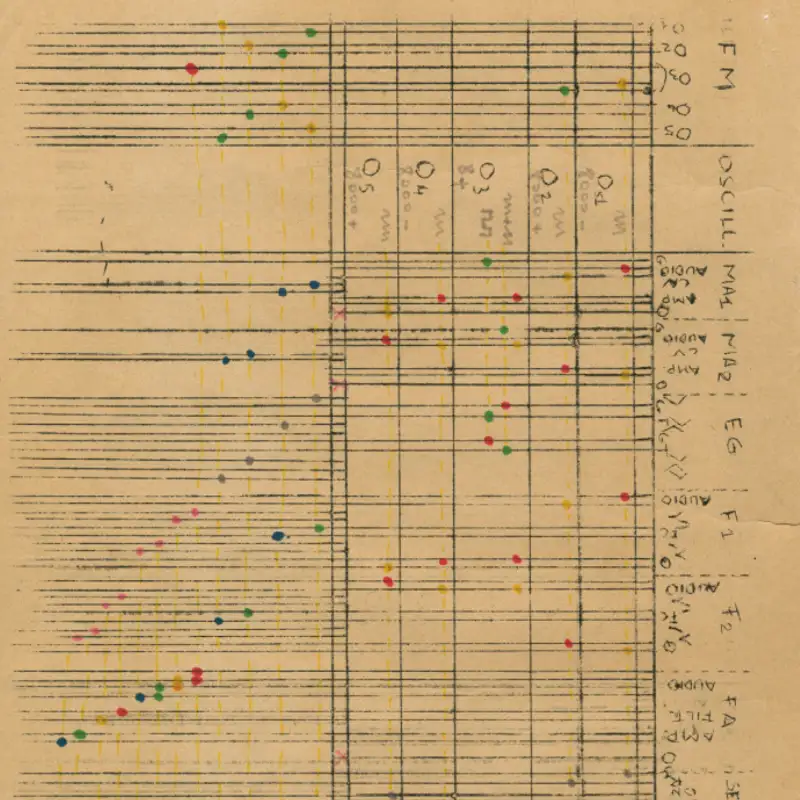
EPISODE 18: Eliane Radigue 01.24.1932 - 02.23.2026
Rest in peace, Eliane Radigue. We'll be paying tribute to Eliane Radigue who left us at the end of last month, I think, 02/23/2026. Yeah. I mean, what can you say?
Justin:There's one there's one thing you can say, which is in the traditional Tibetan Buddhist framework, you spend forty nine days in the Bardo, where she is still for now, because I don't think it's been forty nine days yet.
Justin:And, hopefully well, fully, I have if anyone is going to come back or maybe she's finished. But, wow, like, the next the next lifetime that that spirit serves is, the greatest lifetime. What gifts she's given to all of us.
Leon:Yeah. So what we heard was the last section of opus 17, which was written in 1970. The last section is called number 17. It's yeah. I chose this piece because it's kind of a transitional piece.
Leon:It's I think it's the last work she did with microphone feedback, which was basically her her material for at the beginning of her her explorations and before she switched over to to synthesizers. Yeah. It's it's kind of you know, the it's a very busy piece. I find there's, like, so much going on even though there's, like, the her, you know, very characteristic, slow development. There's still such a richness to to all the different sounds that that that come up.
Leon:And it's also it completely astounds me how she was able to just create something so personal from just microphone feedback, which, I mean, it just speaks to the complete utter mastery of of of the craft, you know, that that she had developed at that point. And that I think that that that created some tension between her and then the the people that she was helping out at the time. So yeah. You know, what a what a master even at that point where she was completely at the at the top of her game, and then she and then she just keeps, you know, keeps going and and just busting up new new worlds open at every at every turn. It's incredible.
Justin:I think, also, for me, a really incredible thing about her whole trajectory is the resistance to capture. That's such a huge part of what what she did. And you think about this like, she was working to add some color to what you just said. She was working as Pierre Henri's studio assistant doing, like, tape cutting and archival work and in a very patriarchal structure that was not really gonna give her the time of day. And just in full, like, joyous resistance just made this body of work during that time period that, to me, is far superior to anything that came out and far more relevant to the time that we live in now, which is super interesting
Justin:Than than the work that was being done by all the famous, like, electroacoustic people and, like, kind of crafting the future of this work, which she's continued to do again and again and again, all without any kind of intentionality of doing of working within the frames of acceptability, of bowing to the hegemon, of whatever. She just applied pure spontaneous, investigative logic to the material at hand. What a incredible, I mean, I think I've learned more from her in terms of an admirable way to live and process and meet reality. Wow. Like, it it extends way beyond what's sonically there, and what's sonically there is obviously entirely remarkable.
Justin:I would challenge one thing, and I I think about the concept of mastery in this because I think one of the things that I really admire the most about Radigue is there's a very, very delicate balance through across all of her work, especially which kind of materializes in the end when she goes back to instrumental not the end. She made a movement back to electronics again at the very end. But in the the near the last second to last stage of her work where she would work with these very accomplished musicians, and so much of the com so much of the work would be this very open space that was very working both with a kind of sense of mastery, but also with a really profound spontaneity and lack of control. Yeah. Yeah.
Justin:Know? And and I think about her her Buddhist background, which I'll talk about later too. But, you know, I think in the tradition that she's from, there's this really beautiful tension between quality of attention and spontaneous openness. And, like, no one has performed that better, And it's just so present through all the stages of her work. Yeah.
Justin:Yeah. So I just wanted to throw that in.
Leon:I I totally hear you on that. And I think the the the problem is with the the word mastery. And she there is a a very radical openness in her approach that that that invites or, speaks with the thing that she can't control. And, that that's basically yeah. You you absolutely you pointed it out really well that that's that's really, like, a very big focal point in her in her work is just this being in in relation with this other thing and in dialogue with this other thing that that she can't entirely control.
Leon:However, when you hear maybe the word I was I should have used is restraint because we're talking about feedback. And we've heard some we've heard feedback. And we've heard people, you know, making music with feedback. And even at even at that in that time, you know, this is not some, like, big explosion, you know, super yeah. It it's not like a big crescendo thing.
Leon:It's just like this uncontrolled thing that's just kinda still reigned in. You know? It's it has tons of room to roam around and and be itself, but she's just set up this kind of this this territory for it to to play in that's that's still, like you know, she still has an idea of of of what she wants, but she's not exactly sure what it'll give kinda thing. It is the feeling I get.
Jacob:I was just gonna say that piece is so punk sounding. And and and I can't I mean, I can't think of anything French that sounds like that. You know? Like, what Justin was saying, like, Eric, Pierre Arri. Yeah.
Jacob:And then you're thinking about all that spectrum music that was happening around that time too, which is just so French, you know, in a good way too, obviously. And this just sounds like completely from a different planet. Like, I mean, not only is it not French, but I can't really think of anything that sounds like that during that time. Like, there's just something way ahead of its time and just the way it formulates, like, a soundscape. It sounds really just really punk, like a really completely different trajectory than and, you know, thinking of, again, the French scene is so academic, and then this thing just comes out.
Jacob:It's so raw and so organic, and so it's really amazing piece.
Leon:That's that's another thing about about Radigue is just her there's a certain rigor to to her approach and her investigations, but it's so intuitive also. It's Yeah. This incredible mix that's really yeah. I I don't think I I know any Mhmm. Anyone who does that that way.
Justin:I think back to that Cassandra Miller piece that we played and not the piece itself, but the the Simone Vile quote that was in the score about, like, absolute attention is prayer or something like that. Like, it's totally I mean, it's what what's so outstanding with Eliane Radigue is the like, it almost exposes that there's this other level of attention that's possible. You know? Like, that you can listen deeper, that you can attend deeper. What a beautiful, beautiful thing.
Justin:And you can be punk while doing it.
Jacob:Yeah. It's so I mean, to me, it sounds so punk.
Justin:Oh, yeah.
Jacob:It's really, really, really, like, liberating music. It's very, very free, and that yeah. It's amazing.
Justin:Yeah. It's amazing when you dig into all like, that stays through all the work too. Like, there's sections of some of the art stuff that is just like, it outdoes any industrial music I've ever heard in my life for how, like, harsh and grueling and and then, like and transcendent and visceral. And then, you know, you also get to the to the instrumental music. And Yeah.
Justin:Yeah. It's just like, holy cow. Like, it's so heavy, but so yeah. What a what a genius. Mhmm.
Justin:That was cool because that was the last piece too. Right? Like, that's the last one of the
Leon:Yeah. That's the last section. It's funny. We're talking about how nothing sounded like that. The the first section of of Opus 17 is like a feedback of a sort of I am sitting in a room treatment with a piano riff.
Leon:And she said that she hadn't heard Lucia at that point and that it was really done. It's exactly the same process, but it was done in, I guess, in isolation from from.
Justin:I also really love how the tip that brings to mind lovely music. So my my mind's jumping there because for a long time, that was the only place you could find her work. And and the the kind of velocity I love how this stuff happens. Like, when we were at Esoterik, there was just starting to trickle out some Radigue stuff, and it had been very not heard yet at that point. And a little bit like the trilogy de la Moire probably was the most famous piece, and people knew it.
Justin:But it was like, she wasn't canonized the way she is now. And and it wasn't like like, we were all so excited about it, but it wasn't exactly easy to ship off the shelves. Like, there was no boards of Canada going on there. You know? Like but the but the but then as, like, kind of I I don't know what makes it happen.
Justin:You know? But you see now, like, everything's in print. People love it. You go to Bandcamp. There's, like like, so many people listening to it, and it's it's so deserved, and it's just so beautiful to see the attention that this music's acquired through time.
Justin:And it's it's almost like the process of her infiltrating the consciousness of the music world is not unlike her compositional strategy. You know? It's this very kind of fluid, slow thing that just now is
Jacob:Mhmm.
Justin:Everywhere. You can't escape it. But it it was a very slow, slow, slow build to the point where she's now such a big part of contemporary music. But thank god that happened.
Leon:Well, I really have to thank Esoterik to for introducing me to Eliane Radigue because I I wasn't I wasn't aware at all of of her music before working there. And the enthusiasm was
Justin:High. It
Jacob:was nice.
Leon:And so I just took it as a given. And, of course, I mean, when when you when you're when you've you're introduced to her work and her approach, it's like, it's undeniable. You can't there's obviously something incredible at work there that's that, like you know? So it's she was one of the grades from the from the start. I just took it as a given.
Leon:But I I didn't realize that at that point, it was it was just the start of, like, the the reissues and but not reissues, but rather, I guess Yeah. Issues. Yeah. Yeah. Of other stuff.
Justin:It's incredible how, like, so much that work wasn't released until Mhmm. The February even. It's crazy. And it's funny because I think about how I first heard Eliane Radigue, which predates Esoterik, and it was this is the beautiful story of the record store chain and the knowledge passing, you know, past the information. Yeah.
Justin:It was me and Gavin at Wall of Sound in Seattle, which was the Climax Golden Twins guys store, and them handing it to us like they were passing us a holy grail. Like, they were just like, guys, it was the trilogy to more and them passing that box to us and me and Gavin being like, woah. What is this? Then it that was in probably '94 maybe. So, yeah, that was a Mhmm.
Justin:Thanks, Rob and Jeff. Jacob, how did you first discover her?
Jacob:I don't remember, to be honest. I think it must have been through Mark. Yeah. It must have been, again, part of that chain somehow through, from yourself from Gavin to Mark. And I I don't recall what it was actually, but it seems like I've known about her forever for some for some
Leon:Yeah. That's fitting.
Justin:Yeah. Yeah. She's eternal. She's eternal.
Jacob:I've I've known about her even before I was born.
Justin:Yeah. We all did. We all did.
Jacob:Yeah. I'm just picking up the baton. You know? Yeah. It's funny.
Jacob:I don't know if you guys have seen the there's like a there's a documentary made with her. Have you seen this? And she's, like, in her house. Yeah. And and it almost feels like you would be visiting your grandma.
Jacob:Wow. You know? And and you go to her place.
Leon:So lovely.
Jacob:And you're like, grandma, what is this thing in the corner of the room? And, you know, oh, that's an ARP synthesizer. Like, it almost feels like that machine shouldn't be there. You know? And and and she just goes about her day, and then she goes to this, like, huge, huge wall of synthesizers.
Jacob:It's a huge arp. And she's just like, oh, I'm making this little piece. It it was such an amazing thing. I was almost like I don't wanna compare it to sewing, but it seems like she wasn't she wasn't part of that scene at all. It was just this thing that she was doing.
Jacob:You know, and and it felt it's just it it looked amazing because otherwise, the house just looked like anybody's grandmother's house. You know? And then you've got this synthesizer in this everyday this relationship she has to be sounds. It's amazing. Yeah.
Jacob:Really amazing.
Justin:Jacob, what do you got?
Jacob:Well, I'm gonna pick you off a little bit of what you said, Justin, a later work of hers that she did with musicians. And so here here we have one musician in mind. And and, I mean, I've always known her work or since I've known of her, it was always the the the synthesizer stuff, obviously, the art stuff. But then when I discovered the the stuff with instruments, it just completely opened an entirely different world. Yeah.
Jacob:And yet it's so her at the same time. Yeah. Like, it's it's really amazing for that. So I'll play this piece. Let me just share my screen.
Jacob:It's pretty transcendental stuff.
Justin:Yeah. Jacob, do you know which version you picked from that CD? Which one that
Jacob:is? This is a live version.
Justin:Okay. Because there's the there's that has the original 02/1961 on it too and that which is the one I'm familiar with, and I I didn't know that version, and that was wow. Incredible.
Jacob:Yeah. So this is a live version of Nelz Gue 02.0. I don't know how to say it, with Charles Curtis on cello. And I don't I mean, I don't know if this is music. I don't know what the hell this stuff is.
Jacob:This is completely yeah. Just speech be speechless, basically.
Leon:This is physics.
Jacob:This is physics.
Leon:Yeah. No. No. For for for real. The whole piece is centered around the the wolf tone, which is like the quote unquote weakest tone on on the instrument that cellists learn to avoid because it's like the most unstable
Jacob:Incredible.
Leon:Unstable tone. And so they they have this thing, this little little mechanical piece that they attach to one of the strings to help stabilize it. But, basically, this is just, like, going, you know, headlong into the wolf tone and just, like, playing with fire.
Jacob:You know?
Justin:I mean, it it goes super deep into the wolf tone too. Right? Like, it's like the three it's I was just I was I had the liner notes in the original one out when I was looking at this. It's wild. Three of the four strings are tuned as closely as possible to the wolf tone, and a fourth string is tuned to a string tension, which will cause the tailpiece of the cello also to resonate at the pitch of the wolf tone.
Leon:It's
Justin:The end pin is tuned to the same pitch by the length to which it is drawn out. It's so crazy. Hey? Like, it's like a resonating machine of chaos. Like Well, this
Leon:is it. It's like I I was thinking about this whole thing about, like, ego when listening to this Mhmm. Because of how also, I I was remembering how Eliane Radigue would would speak about her, you know, moving on to different instruments or different techniques and how after the the microphone feedbacks and she she was introduced to the synthesizer, she's like, oh, this is exactly what I've been looking for all my life. You know? It can do everything that I've ever dreamed of and more.
Leon:And then when she started collaborating with with instrumentalists, again, it's like, oh, this is exactly what I've been looking for all my life. It can do everything that I've ever dreamed of and more. And and and it's like basically, these pieces are are she she's not a composer anymore. She's she's she's not
Justin:It's metaphysics. It's metaphysics.
Leon:She's not actively acting on it. She's more like almost the the French term in in in sorry. The French word is, like, for for director for a movie Yeah. Which is basically, like, you're setting up a scene. And that's what she's doing, you know, with these these collaborators.
Jacob:That To me, it's to me, it's so similar also. Just sorry to interrupt, but the feedback piece you played is so similar to this in
Justin:a weird way. Yeah. It's continuous.
Jacob:It's so continuous.
Leon:Of course. But then there's the actual instrumentalist, the
Jacob:performer. Absolutely. Absolutely.
Leon:And in this case, I think it was the first piece she's done with live instruments, and it it was Curtis who approached her to do something together.
Justin:It's it's not true.
Leon:And this
Justin:is really interesting. And I almost there there were two other pieces that I wanted to play that I'm not gonna play, and the one piece I wanted to play was the first instrumentalist piece. So the this piece is really interesting because it kind of unearthed the process by which I would say the whole Occam series Yeah. Evolved. And and it was the late but she actually did a piece about six years before this with an electric bassist called elemental two Oh.
Justin:That is fucking mind bending. Oh, wow. And it is I there's a live version I'll put in the show notes because I'm not gonna play it, but there's a live version of that that, like, the title is so and it's really it's it's almost it was the thing I was thinking of when I was saying that she's way more intense than any industrial music I've ever heard. That is like, it starts with the boiling speakers that from our other show effectively as a soundscape and then goes into, like, like, symphonic metal. And, like, it's so wild.
Justin:It is one of the strangest pieces of music, but it really doesn't lean into where this goes. So in some sense, like, I think why this piece is canonized as her first instrumental piece is it kind of set the the path Right. For the future. And the one other thing I wanted to add to that, the other piece I'm not gonna play that I think is unfortunately really sad I'm not gonna play because I think it's really critical. So many reasons to this moment.
Justin:One of the last pieces she did was with AI.
Leon:Wow.
Justin:And it's phenomenal. And it's a really extraordinary extraordinary piece that she did with machine learning. And I think that and and Leticia Sonami, I think, was was the collaborator, but it's it's really worth looking up as well. But the thing to me that's really exciting about this is that, like, the fearlessness of it and also the the so to me, it's really interesting if you think of her. This is so nerdy.
Justin:I can't believe I'm gonna be this nerdy. But if you look at her relationship to kind of out of and and, like, the music concrete space and, and being something quite quite, like, evolved in some massive metaphysical other layer than that that just keeps unfolding and has so much more impact on the modern world. It's really and I'd argue that her music really performs a similar function to Alfred North Whitehead in in the sense that he was, you know, basically fundamentally involved in what became logical positivism and Bertrand Russell, all like, you know, and totally freaked those people out by just going the completely other direction into the process metaphysics, which is now extraordinarily relevant to the modern world. It's like the return with to him from Isabelle Stengers and Bruno Latour and etcetera, etcetera. And, like, the there's such a beautiful kind of parallel to me between between the two of them.
Justin:And and this is very much, like, process philosophy as music. Like, really, it seems so Yeah. So in sync with that.
Jacob:The thing I also really like about this piece and going back what you said, I think, Leon, it's like trying to somehow control something that's not controllable. Yeah. Something that's larger than you. Right there. And and with the with the microphone feedback, it's really that.
Jacob:And here by choosing, you know, instrumentalists, they become that unknown a little bit. You know?
Leon:And and I love that. But it's like it's it's like hyper that because then there's also the instrumentalist versus their well, and their instruments. Yeah. Also Yeah. Which is another layer of letting go.
Leon:Yeah. But also, like, again, the it's the wrong word, but it's the only one I wanna no. It's the one I don't want to use, but I it's the only one I can use, the the mastery of their instrument, which is the mastery of letting go, mastery of of having it speak for itself. And, like, every single part of the cello is is is speaking in this piece, and it's incredible. It's incredible.
Jacob:Yeah. It's really rich.
Leon:It's so beautiful.
Jacob:It's quite amazing. It's so transcendental to me. I mean, I've been, you know, kind of un kind of related, but it wasn't part of the plan. I've been reading actually the Tibetan Book of the Dead these days. Oh.
Jacob:And that piece of music is like reading that book. Like, it really feels that kind of pulsating just through the prose that's in that. You feel that pulsating kind of energy that just goes through all these themes. And, like, the the whistles at the end of not the whistles. It sounds like whistles.
Jacob:That that it just feels like it's part of this cycle. It's amazing. Yeah.
Justin:It's the space whistles, man. It starts out in the ground and winds up in the space whistles. It's I love it.
Leon:Honestly, like, no fucking tricks. You know? It's just like Yeah. Just cello. Go for it.
Leon:Man.
Justin:It's it's It's meeting the immediacy of the real. Like, this is the there there's a beautiful quote from the I just wanna read from the liner notes because it's so spectacular. It's like, from an outwardly directed act, tuning is turned tuned inward, seeking an audible structure of interiority. The resting point is not exactly unison, but the gap of a semitone. The cello tuned with extraordinary effort yields a specific differential that appears irreducible.
Justin:The search for self sameness reveals a unit of distance we would not have discovered without having attempted to bridge it. We cannot bridge it because it is inside. The object sought is contained in the subject. Tuning to it is the painstaking calibration of the difference that is the self. Right.
Justin:So great. Yeah. So great. And that's Charles Curtis writing about it. Like, the I I also think Jacob too for the Tibetan Book of the Dead, I believe trilogy to L'Amour is based on on that.
Justin:So that, like or, like, in some other things, but very, very beautiful to listen to that and read that at the same time too. Yeah.
Leon:Was also thinking about taking going back a bit about how, you know, in the February, stuff started coming out, but so much of it had remained unreleased. I guess the major obstacle was just the length, basically. Like, CDs had to come around before But Yeah. That also points to how, you know, the the how she escapes capture, basically. Just, like, wanting to you know, just making the the the sound installations and the the the performances be the the only Mhmm.
Leon:Manifestations.
Justin:I do believe she released some stuff on reel to reel in the early days, which
Leon:is pretty awesome. Alright. Yeah.
Justin:Makes a lot of sense. It's pretty great. Like and especially in environments where you could play the tapes at multiple speeds at different yeah. Pretty great. I think vice versa was released like that originally.
Justin:Yeah. Wow.
Jacob:Mhmm.
Leon:Wow.
Justin:And the thing too, like, so much of this stuff like, I remember getting industrial records in the eighties where it'd be like, you can buy this in three seven inches and play it on three different turntables, and it'll be really trippy. You know, and, like, really gimmicky.
Jacob:Yeah.
Justin:But but the reality, I think I've only really experienced with her and maybe Phil Kniblock where the the listening environment you listen to this music in is so radical part of how you experience it too, like, which is, yeah, like, really, really, really powerful. Like, it's so like, you know, like you said about physics, Leon, it's like it's so much about the the material of the real in a really profound way.
Jacob:Did you guys end up, by the did you guys, by the way, end up seeing, like, Phil Knit Block Live when he was in Montreal? Did you see him?
Leon:I think was like Didn't we do it was a store outing. I think we were all there.
Justin:Yeah. Yeah. We were all there. Yeah.
Jacob:And you're and you recall he was just, like, walking around the space? It was amazing. Yeah. It's really amazing.
Justin:Yeah. I got to go to experimental intermediate a couple times, which was his loft in New York, and my friend Antonin Sorrell actually lived there for a while with him. And it's like and they'd have these it was hugely inspirational, Antonin's story about about experimental intermediate. It really influenced me in Dana's space and the way that we do stuff here and just this really beautiful like, they just made sure they had family dinner every night with any of the weirdos that were floating around and really created this social flow of and so much interesting, you know, music and whatever evolved out of there really. Yeah.
Jacob:Yeah. It's amazing.
Justin:I think there's a there's actually an Eliane Radigue disc on experimental intermediate, I'm pretty sure.
Jacob:Yeah. There's like a there's a couple
Justin:in the yeah.
Jacob:There's the trilogy that I'm on, and then there's a I forget there's another one. Yeah.
Justin:Trilogy's on on Lovely, I think. But Is it? Yeah. I'm pretty sure it's on Lovely. But the experimental intermediate, I mean, he was a huge one of the only channels to listen to her music early for sure.
Justin:Yeah. Sympathetic people. Yeah. It leads me beautifully into my piece, which Jacob knows what I'm gonna play already because you guessed.
Jacob:I'm assuming. Yeah. I think
Justin:I think it's obvious. But the this is a huge thing for me because I I I practice, you know, and and that there I really wrestled with that for a long time because of California Buddhism. And Eliane Radigue really led me was one of the things that led me to my current life, and I'm very, very grateful for it. And and I remember, like, the kind of European take on on Tibetan Buddhism and and Buddhist practice is really different and has a really different energy to it than the California stuff. Respect all the people in California.
Justin:It just was not I was too close to it. It wasn't my my vibe. But they really opened up something. And and, also, this other person involved in this, who has never been played on the pod, which I can't believe, is, of course, Robert Ashley, who's gonna do some very beautiful, amazing, full Robert Ashley, ness in this piece is just so fantastic and was also a huge promoter of her music through Lovely. And what a great way to introduce Bob to the to the pod.
Justin:And I think that, you know, for me, this is such an outlier in Eliane. It's really fun to end this on this because we haven't had any of the art music. This is one of the art pieces, which is great, but it's also so far out from anything else that she did. And, is a devotional piece on some level, but also is quite funny. And, like, really, I I struggled with this record.
Justin:It's now one of my favorites and actually probably one of the ones I've listened to the most overall, but it is it's like the dinner theater version of it. It's like a it's a wild it's a wild thing to end this on, but I also think it's really profound and beautiful and know her practice was essential to everything that she did and to the way that she thinks. So it's nice to, it's really nice to end with this with this piece.
Jacob:So It's amazing. Good choice.
Robert Ashley:Jetson stayed with the five of his disciples in White Rock Horse Tooth Cave until cool autumn weather arrived. The young rabbis asked their lama, Now it's autumn. Shouldn't we gather provisions for winter practice by begging supplies? By doing so we could help those beings gain merit and also it would be a joy to visit the statue of the precious Lord Buddha in Kirong. Please let us go.
Robert Ashley:The lama replied to them, the precious Lord is complete within yourselves and also it's not so fine for yogis to be begging food therefore take up the practice practice of these eight Vajra paths. And he sang this song for the young repas in White Rock Horsetooth Cave. Glorious incarnation of universal ruler. Best cure for the sickness of the three poison. The excellent man of Lodrach.
Robert Ashley:To Marpa, the translator, I In this best of retreats receive song of the natural state experience. Hear this song by brother children, Lodro, Shergon, Dorji and others, the eternal changeless fundamental consciousness is path guide to freedom from samsara. Happy is one who knows samsara and nirvana are not too wondrous the cultivation of this crop. This whole true lama is the path guide for clearing the darkness of ignorance. Happy is one who sees lama as Buddha, wondrous the ceaseless admiration and faith.
Robert Ashley:This mountain retreat without direction is the path guide for nourishing concentration. Happy is one who treats the body as retreat. Wondrous is immutable of our ding. This objective world appearing to the senses is the path guide for cultivating spontaneous awareness. Happy is one who has directed them to the central channel wondrous this pervasion of body and mind are bliss.
Robert Ashley:These percepts for transverse consciousness are path guides for overcoming the visions of Bardo. Happy is one who can cross with awareness, wondrous this conflicts of past, present and future. The precious embodiments of love and compassion are path guides for impartial help for beings. Happy is one surrounded by the realized. Wondrous is help by emanation body for beings.
Robert Ashley:This cultivation of pure undistracted absorption is the path guide for refining awareness. Happy is one who knows the actual as non dual. Wondrous, this awareness pure as space. This cotton robe upon your body is the path guide for mastering these harsh snow mountains. Happy is one who sleeps naked in snow.
Robert Ashley:Wondrous this freedom from heat and cold. The song I sang of eight Vajra Paths is itself a path guide, voice self voiced like echo. Happy the yogi who remembers the song of experience, wondrous the self voiced Vajra sound. I offer this song of worship, holy lama. Share in this feast of sound, host of Dakini.
Robert Ashley:Remove your obstructions, nonhuman. Attend this auspicious song of worship. As he sang, flowers fell from the sky, and a never before experienced perfume was smelled. Each of the five disciple repas experienced a different vision. Together they paid respects and offered a mandala with fervent request that Mila remain with them.
Robert Ashley:Inspired by such uncontrollable faith, favorable meditation experiences were kindled at them and they were made renewed and they made renewed effort in practice.
Justin:So that is song of the path guides from songs of Milarepa with Lama Kukai Rinpoche who authored the translations of Milarepa's stories that they're reading and also performed them there. And Bob Ashley, of course, yeah, the greatest voice of all time doing the English reads of that. Milarepa, for people that don't know, is quite a profound figure. Nondual Buddhism is quite different than dual Buddhism, and is a great figure in relationship to that. He's one of the most consequential figures in Tibetan Buddhism.
Justin:He was he killed dozens of people through black magic and was kind of this really evil evil dude and then felt really, really bad about it and and looked for a teacher. And Marpa, who they're talking about in that, who's the the teacher the tran Marpa, the translator, was his teacher. And he basically made him build towers for, like, tons of years, and he just built towers over and over again and turned them down and very Sisyphean, and it transformed him. And he was burning the karma through his body, not through doctrine, which is also really interesting. And then he went to caves and lived with absolute frosty and became transcended all his karma in one lifetime, which is also very rare, and then would go around and meet people and sing these songs that of which this is one of them or a couple of them fully spontaneously when he would meet people and and deliver dharma very specifically to very specific instances.
Justin:So this is a beautiful, beautiful, beautiful piece of Buddhist transmission that's quite quite beautifully perfect in a ton of ways. Also, really interestingly, this was recorded very close to the same time as Perfect Lives. So the speaking kind of terrain that Robert actually had developed was this is really contiguous to the birth of that methodology for speaking. So would love to know more about how he became part of this piece. There's not much documentation on that.
Justin:And, Jacob, you were right. It trilogy of the Mars on Fielding of Luxembourg, I looked it up, and I was wrong about that. But, yeah, this is a life changing piece of music for me that I go back to all the time.
Leon:That's right.
Justin:Not bad for dinner theater.
Jacob:Yeah. I was gonna say I feel I feel so cleansed in an amazing way, and god bless this podcast. I mean, and just spending an entire kind of two, three hours, almost three hours with Eliane Radigue and ending with this piece. I mean, I should do this every goddamn Sunday. This life is unreal unless you don't have something like that every Sunday.
Jacob:Yeah. For sure. It's an amazing amazing experience to listen to these three pieces, and ending with this one was amazing.
Leon:Yeah. So beautiful. I I I do remember the, you know, some some people poo pooing this this record because of how I don't know. I guess maybe programmatic is is a work, but it's it's really I mean, it's got all the ingredients. It's just so so beautiful.
Justin:Yeah. And it's it's so like, it's also goes really like, to me, there there's something compositionally that's super similar to the Charles Curtis thing.
Leon:Mhmm. Yeah.
Justin:Like, in the sense that it's going super deep. Like, it's her teacher. It's his translations. Mhmm. It's Bob Ashley doing this flat affect thing that's mimicking the style of the Tibetan singing.
Justin:Like, there's so many layers of going deep into the into the material. I think it's what's interesting is I think what where people neglect this piece is that the the accessibility of it like, it's by far the most accessible piece in Eliane Radigue's catalog, like, to a non twentieth century music listener. There's something to hold on to in a way
Leon:Yeah.
Justin:That doesn't, that's unfamiliar in her work. And to me, that's this tremendous act of meta. Like, it's like this very generous piece. Like, it's like, okay. Welcome.
Justin:But it has all the formal rigor and and all the intensity of the other work, especially, like, durationally. Like, this this this this whole album is, like, two hours long, and it's so it's so great. Great way to spend the Sundays listening to the whole Yeah. Amazing. It's a I've done it many Sundays.
Justin:It's great. It's really, really great. But what a loss to and and what a gift. And, also, I really wanna say something that was just, like, raging inside of me. Like, fuck Beethoven.
Justin:Fuck Mozart. You know, fuck John Cage even for being a self aware court musician. Like and I I remember this conversation where or this reading this context, this com this interview with Cage where he's talking about him and Harry Parch and saying, you know, the thing that Parch got wrong was that Parch wasn't a court musician, and you need to know your place. And that Cage was doing everything he did in the context of being a court musician, which basically means being a subject to the class war that we all have lived in and have lived in for all of eternity. And what's so beautiful with Radigue, she just steps out of that.
Justin:She's like she's like, I'm I'm not making this for the ruling class. If they wanna come to my little apartment in Paris and see my cats and my and no. For real. Like, you know, if they wanna come to me, they can, but I'm I'm making this music as an act of devotion and love, and and it's so radical. It's just it's so like, and god bless her.
Justin:Like, you know, like, or Buddha bless her, like, yeah, or whoever. I don't know. But the like, it's just it's so inspiring to me to have that as a radical practice. Like, it's the greatest thing on earth. Like, what an extraordinary human being.
Jacob:Yeah. Absolutely. I mean, I have to say also I'm a really big fan of, like, people who I mean, how to how to put this? Like, they they make the same song all their life. You know?
Jacob:Yeah. Yeah. Yeah. Yeah. I'm really a big fan of those kinds of people.
Justin:It's like Yeah.
Jacob:Yeah. It's just that one song that they just keep like, they're from birth to death, they've been doing it, essentially. And and I love musicians like that or composers like that where it's just that same song. Know. Through all the years.
Leon:I'm remembering the young that's a guy talking about being the, you know, the needle that plays the universe's record.
Justin:Yeah. Yeah. Yeah. Basically. Store is open.
Justin:Welcome. It's great. Love it. You guys, it's Yeah. This was one of my favorite ones.
Jacob:That was amazing experience.
Justin:So far. Thank you for, hopefully, we don't have other people we love die, so we have to do this again. But
Leon:maybe we don't need to wait. You know?
Justin:Yeah. That's true. That's true. It's interesting. I was telling Larry was emailing me back and forth about a Richard Young's best of list Yeah.
Justin:Yeah. That I gotta get on, but, you know, like, that's it's it's a really good point. And, man, I could do six hours of Eliane Radigue. I feel like we barely scratched the surface. It's Yeah.
Leon:I mean Yeah. It it was a great great idea, great proposition. Mhmm. Felt daunting as an idea, and then it's just, like, most natural thing in
Jacob:the world. The
Justin:other thing that was amazing was, like I mean, I was already doing this a bit because of her passing, but, like, going like, we do this, like, the choices I make are so serious to me. And, like, man, I've listened to so much Radigue in the past, like, month because of wanting to really think through how to present this work. And what a wonderful month it's been. Like, you know, terrible weather here, tons of snow, like, and just, like, Radigue everywhere all through the last month. So beautiful.
Justin:I was re I was thinking about the Bardo too because if you're good at it, you get out fast. So she might not do the full forty nine days. I think she might be gone already. So but, hopefully Well,
Leon:maybe she wants to.
Justin:Yeah. She wants to chill in
Jacob:the Bardo for a while. She's like,
Justin:oh, there's the scary faces. Hi, guys. It's scary. Great. Yeah.
Justin:Thank you guys so much. That was really extraordinary. Yeah. And thanks to everybody who made it to the end and and are with us still after nineteen epis is this episode 19?
Leon:18. Oh. 18. Wow. We turned 18.
Jacob:We turned 18.
Justin:We made it. We were gonna have that really raucous 18 episode.
Leon:That sounds the best. 18.
Justin:We nailed it. This is, like, reminds me of Gavin's bachelor party where I got together with him and the Climb Ice Golden guys, and we listened. DJ seventy eight said cast. Very ruckus. Very ruckus.
Justin:Yeah. Awesome.
Leon:Great. Thanks.
Justin:See you guys in a month.
Jacob:Good to see you guys. Thank you.
Leon:Goodbye. See you guys.